When did the grid stop being just wires?
For most of the last century, the grid was a wonderfully boring thing. Wires, plants, substations, demand curves. The engineering was hard, but the moral questions stayed politely out of sight. Reliability, price and emissions. That was the conversation.
That is changing because of scale. By 2050, the grid will be balancing rooftops, cars, home batteries, heat pumps, factories, data centers and whole neighborhoods, all of them both using and producing power, all of them talking to the system at once. No human control room can coordinate that. So a new layer takes over: an orchestration system that decides, in real time, which loads are critical, which are strategic and which are comfort.
Functionally, it becomes a central bank for electricity. Under stress, it slows some demand, redirects power across regions and sends signals to billions of devices in the same second. Nobody switches it off, because it is woven into everything.
And that raises the only question that really matters: what is it optimizing for? Lowest cost? Lowest emissions? Least human suffering? Stability for the customers who pay for priority? Each answer builds a different society. Right now, that choice is being made by vendors, operators and policy bodies, and most of them have not said out loud that they are making it.
The grid is not neutral. It decides who gets power, when, and at whose expense.
Why is “what should it optimize for” a leadership question?
Before I became a speaker, I spent nearly two decades in HR, the last years of it running a management academy. If there is one thing that job teaches you, it is that every system has values built into it, whether anyone wrote them down or not. The bonus scheme tells people what really matters. The promotion criteria tell them who the company really is. The values poster in the lobby tells them nothing.
The grid is about to learn the same lesson at national scale. An optimization goal is a value statement in disguise. “Minimize cost” sounds technical until it means the neighborhood that pays least gets cut first. “Minimize emissions” sounds virtuous until it means the factory that employs half the town goes dark on a windless week.
That is why I am wary of anyone who calls this an engineering decision. Engineers can build the system to pursue any goal you hand them, beautifully. They cannot tell you which goal a community will forgive you for.
An optimization goal is a value statement wearing a lab coat.
What happens when carbon caps stop being targets?
Carbon caps are moving from soft promises to hard limits. The EU Emissions Trading System already prices carbon at levels that change how industry behaves, and other regions are following. By mid-century, households, companies and AI workloads will manage three budgets at once: money, time and carbon. Clean energy for essentials will be plentiful. High-impact use will be capped, gated and rationed.
The consequences that keep me up at night are not technical ones. They sound more like this:
- A hospital hits its carbon limit during a heat wave. Do you cut its cooling or break the cap?
- A plant reaches its ceiling halfway through the quarter. Does the line stop, and who tells the workers?
- A district overspends its allowance keeping elderly residents safe during an evacuation. Who pays for that override?
- Two cities both claim the last of the regional allowance for the same cold snap. Who referees?
None of these will be answered by a model. They will be answered by people, and the only question is whether those people prepared in the calm or improvise on live television.
When the cap binds, someone chooses. Make sure it is not your reflex.
Which three demands will every load have to defend?
Here is a frame I find useful, and it tends to make rooms go quiet when I share it. In the future of energy, every load sits inside one of three competing demands. Each moves on its own. Each is increasingly hard-coded into the orchestration logic.
Survival. Hospitals, water, public safety. The loads society cannot drop without consequences nobody wants to explain. Transition. Industrial change, electric mobility, agriculture adapting to a new climate. The loads that decide whether an economy is positioned for the future or stranded by it. Repair. Carbon removal, ecosystem restoration and the first experiments in climate repair. Loads that exist only to undo damage, at an energy intensity no industry has ever needed.
Treat any one of the three as the only priority and the other two fail you. Lean on survival alone and the transition stalls. Lean on transition alone and you are explaining a blackout at a hospital. The leaders who can argue for their loads in this language will keep their districts and clients near the front of the line. The ones who cannot will find the orchestration layer has quietly argued for them.
Survival, transition, repair. If you cannot say which one your load serves, the algorithm will decide for you.
Why is your position worth more than your uptime?
For fifty years, energy relationships were built on one number: uptime. How often did the lights stay on? How fast did they come back? Contracts, bonuses and reputations were all written around reliability.
That number is losing its crown. When the system has to choose between a hospital, a data campus and a residential district in the same stress event, nobody asks how reliable the power is. They ask who gets it first, and why. And customers will start asking questions utilities have never had to answer in writing. What are my priority rights during a heat wave? Where exactly do I sit in the hierarchy? What triggers my deprioritization, and who do I call when it happens?
Some of the customers asking will not be people at all. Data centers will bid for priority automatically. Industrial AI will shift demand across regions on its own. Cities will negotiate their resilience level in real time. The product is quietly changing from kilowatt-hours to a place in line. The providers who explain that line clearly will be trusted. The ones who hide it will be audited.
Reliability was the promise. Position is the product.
Who are the new customers with no face?
This is the part of the future of energy that still sounds strange to most people, so let me be concrete. Microsoft agreed to buy power from a restarted Three Mile Island reactor for twenty years to feed its data centers. Virtual power plants from companies like Tesla and Sunrun already pool thousands of home batteries into something that behaves like a power station. None of that is a forecast. It is in this year’s planning documents.
Follow that trend a decade out and some of the largest buyers on the grid will be machines buying for machines. They do not vote. They do not show up at town hall meetings. They do not care about the elderly couple three streets over. They have contracts, and contracts are very good at being enforced.
I find that genuinely fascinating, and a little unsettling. Because the moment your biggest customer is an algorithm, every human customer becomes a question of policy rather than a relationship. And policy, unlike a relationship, has to be written before you need it.
Your largest customer may soon have no face, no vote and a very good lawyer.
Which five skills will energy leaders wish they had built?
The question I keep getting after keynotes in this space is a practical one: what should I actually learn? My honest answer is that the skills that built the last era are not the ones the next era pays for. And this window, right now, is when they get built or skipped.
- Systems literacy. Reading what the orchestration layer is doing, and noticing when it is optimizing for the wrong goal.
- Carbon fluency. Understanding caps, allowances and trading well enough to argue about them, not just comply with them.
- Governance design. Writing the principles for who gets priority in a crisis, before the crisis writes them for you.
- Cross-border thinking. Seeing resilience beyond your own grid, because your grid is already negotiating with its neighbors.
- Moral framing. Walking a board, a regulator or a frightened community through why one trade-off is acceptable and another is not.
Notice what is missing. Not one of these is in a traditional engineering curriculum. All of them will separate the people running the industry in 2050 from the people being run by it.
The technical skills got you here. They are not the ones that keep you in the room.
What will humans still decide that algorithms cannot?
I am not someone who believes AI is coming for every job. I am also not someone who believes it will politely stay in its lane. In energy, the line is fairly clear, and it is worth naming, because naming it is what lets you invest in the right things.
AI cannot choose the goal. It will chase any goal you give it with extraordinary skill, which is exactly why choosing the goal becomes the job. AI cannot own the trade-off. When the system recommends cutting cooling to a building full of elderly residents during a heat wave, the override, and the responsibility for what happens next, stay human. And AI cannot hold a community through a long crisis. The trust a town extends to its utility over three dark days is built on a person standing in front of them, not on a dashboard.
This is where the human edge in energy compounds. Not in doing what the machine does, a little slower. In doing what the machine was never built to do.
AI will chase any goal you give it. Choosing the goal is now the entire job.
Who will lead energy in 2050?
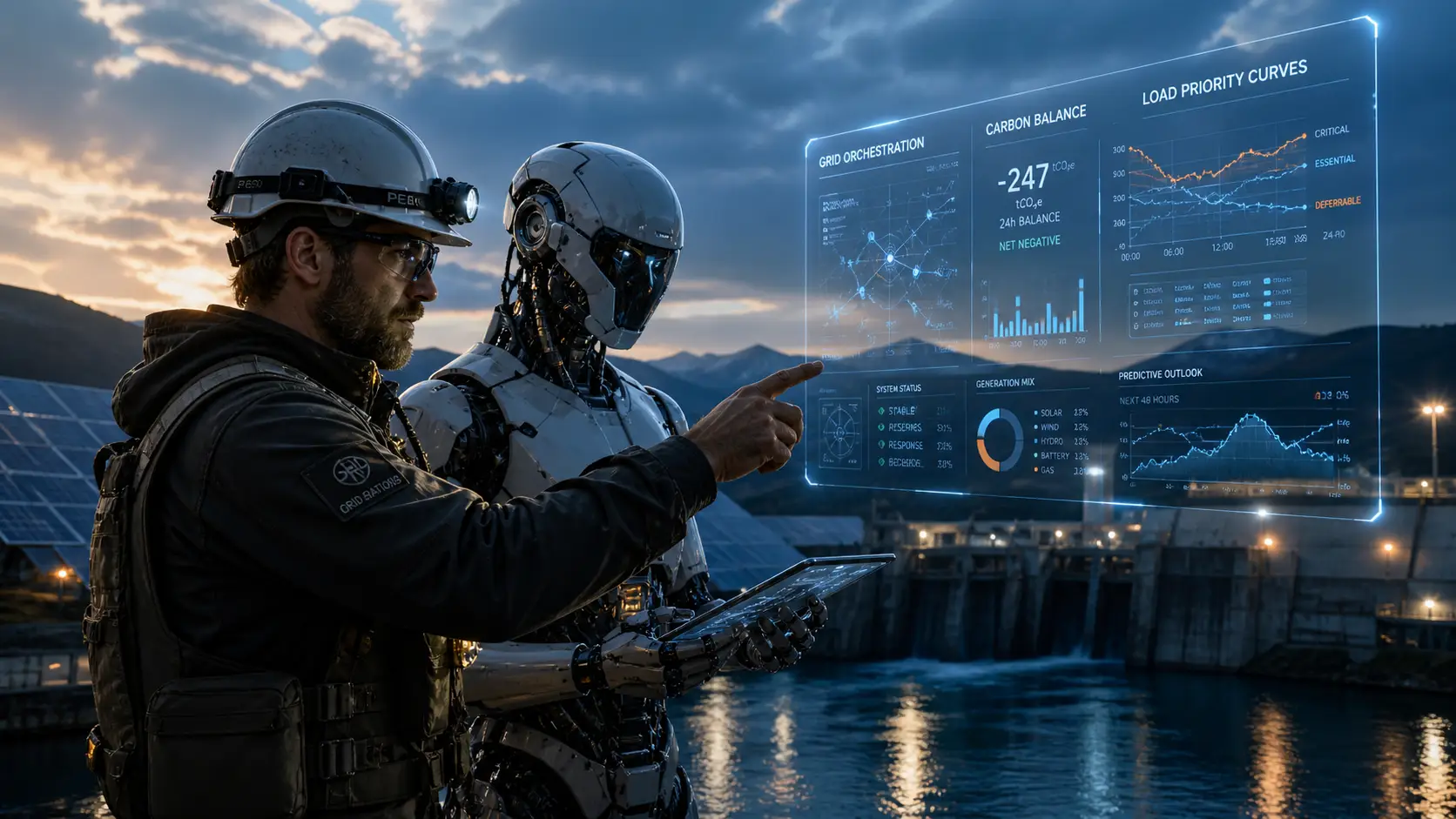
Not the most brilliant engineer in the building, although that person will matter. The energy leader of 2050 is a moral system designer: someone who reads carbon, capacity and political signals at the same time and turns them into logic that holds up when things go wrong. Stakeholders trust them with the long-term call, not because they are the most efficient operator, but because they can explain their reasoning and their judgment has held through more than one storm.
And they have one quality that never shows up on a résumé. They are willing to refuse an optimization that is efficient, legal and wrong, even when every short-term number in the room argues the other way.
That person is being shaped right now, by small choices that look like nothing. Which report they read this quarter. Which uncomfortable conversation they start with their board. Whether they practice overriding the machine before they ever have to.
The 2050 energy leader is being built this year, one unglamorous decision at a time.
Forever Human
The grid will soon decide who gets power first. It cannot decide who should. My book Forever Human is about that kind of judgment, and why it becomes more valuable the smarter the tools get.