
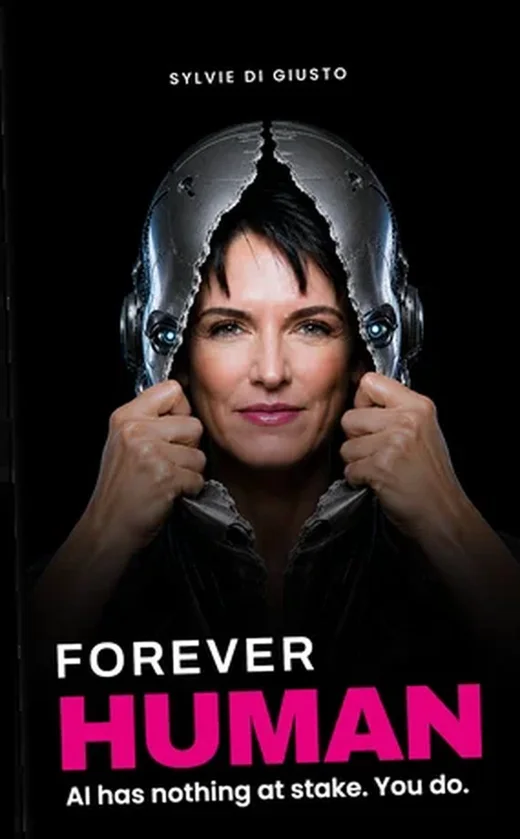
The book behind the keynote: what machines can do, and what only people can.
Machines can copy your skills.
They can’t copy you.
FOREVER HUMAN: AI Has Nothing at Stake. You Do. is Sylvie di Giusto’s forthcoming book for anybody whose name ends up on a decision. It does not take a side in the tired argument over whether AI will replace your job. It argues that the argument itself is the wrong one. Every earlier tool made you pay for what it produced, in hours, skill or money. AI hands its output over for free and leaves the bill with whoever signed. That changes where professional value lives. The book works through ten places where what a machine does and what you do are categorically different, from Speed vs. Timing to Instruction vs. Intuition, and shows that each one resolves on the same axis: whether the one deciding can be harmed by the decision. Not anti-machine, stubbornly pro-human, and written for the version of you that asks the harder questions late at night, when the inbox is finally still.
AI is fast, tireless, and frequently right. It also has nothing at stake.
AI has cognition. You have consequence.
AI can be relied on. Only humans can be trusted.
AI is fast, tireless and frequently right, and it has nothing at stake. As cognition gets cheap, the scarce input becomes a human willing to put their name on the call and bear the cost of being wrong. FOREVER HUMAN argues that this capacity, not speed or output, is what will make professionals irreplaceable over the next twenty years.
It opens with why this moment is different, works through ten pairs of what machines do and what only people do, and closes with what is at stake for you.
Get launch news and the first chapter before anyone else.
Forever Human started as Sylvie’s keynote, delivered as a 3D immersive experience and as a traditional keynote. The book takes the same message further, with room for the research, the stories and the tools audiences ask for afterwards.
Publication date to be announced. Join the list to be the first to know, and to get the first chapter early.
FOREVER HUMAN argues that this is the wrong question. AI will absorb more of the procedural work of leadership than most people admit, and it should. What it cannot do is put its name on a call and live with what follows. When cognition gets cheap, the leader willing to bear the cost of being wrong becomes more valuable, not less. The book builds this case across ten contrasts and in its chapter Something to Lose.
The book's answer is not a list of soft skills but a single axis: whether the one deciding can be harmed by the decision. Timing, meaning, transformation, invention, empathy, context, character, nerve, conviction and intuition each carry a price a machine never pays. Each paired chapter of FOREVER HUMAN opens with a map of the traits that will stay scarce and closes with practices to build them.
Reliability only requires that a machine behave as designed. Trust requires the capacity to fail you, and the choice not to. You cannot trust something that has never had anything at stake, because you have no idea how it behaves when behaving well is expensive. FOREVER HUMAN develops this distinction in Who Comes To You, the chapter about becoming the person others call when a decision is hard.
Use it, the book says, and let it keep getting better at everything archival: records, dashboards, analysis, first drafts. The risk is not in using AI. It is in confusing its side of the work with yours, and passing along its confident output with your name on it. FOREVER HUMAN closes with the Forever Human Map, including an exercise for finding which decisions in your organization have nobody answerable for them.
Not by competing on the machine's terms, getting faster and more available. FOREVER HUMAN suggests taking the time AI frees up and spending it on the part of your work only you can do: the hard conversation, the strategic call, the judgment under uncertainty. Most professionals simply fill the saved hours with more of the same. The opening chapter, Yes, This Time Is Different, explains why that trap is so easy to fall into.
The keynote is the live experience. The book goes deeper, with the research, the stories and the practical tools behind it.
Yes. Event organizers can reserve copies for attendees through Sylvie’s team.