AI Decisions vs Human Choices: The Difference That Costs You
You sat in a meeting last week where someone said the words “the AI decided.” Maybe it was an HR tool that decided who to interview. Maybe it was a forecasting model that decided where to cut spending. Nobody pushed back on the phrasing because the phrasing has become so common lately. The AI decided. The system decided. The model decided. And quietly, almost invisibly, the line between AI decisions and human choices keeps moving.
It is happening at every level of an organization right now. The recruiter who sees the screened-out candidates and shrugs. The pricing team that defers to the model and reviews the results next quarter. The board that watches a forecasting dashboard. Each of those moments is a small reassignment of authorship from human to system, made so casually that nobody in the room thinks to flag it. The phrasing carries the weight, and the weight gets heavier the longer no one says anything about it.
There is a deeper distinction inside the AI decisions vs human choices framing that gets buried by that language. A decision is the output of a process. A choice is the act of standing behind that output, in your own name, with your own consequences. We are training a generation of leaders to confuse the two, and the cost shows up in the moments that actually matter most.
KEY TAKEAWAYS
- AI decisions vs human choices are not interchangeable terms. One is the output of a process. The other carries weight, accountability, and meaning that no algorithm replicates.
- The phrase “the AI decided” quietly shifts authorship in a way most leaders have not audited. Watch the language in your own meetings.
- Pattern matching is fast. Pattern matching is also yesterday at scale. Wisdom often demands the opposite.
- Most of what defines leadership lives below the conscious decision-making layer. AI cannot follow you there.
- A decision becomes a choice the moment you sign your name to it. That signature is what you are paid for.
- The most valuable leadership question of the next decade is not what AI can decide for you. It is the choices you refuse to delegate.
- The future of human and AI work is amplification, not replacement. AI handles the decisions. You handle the choices.
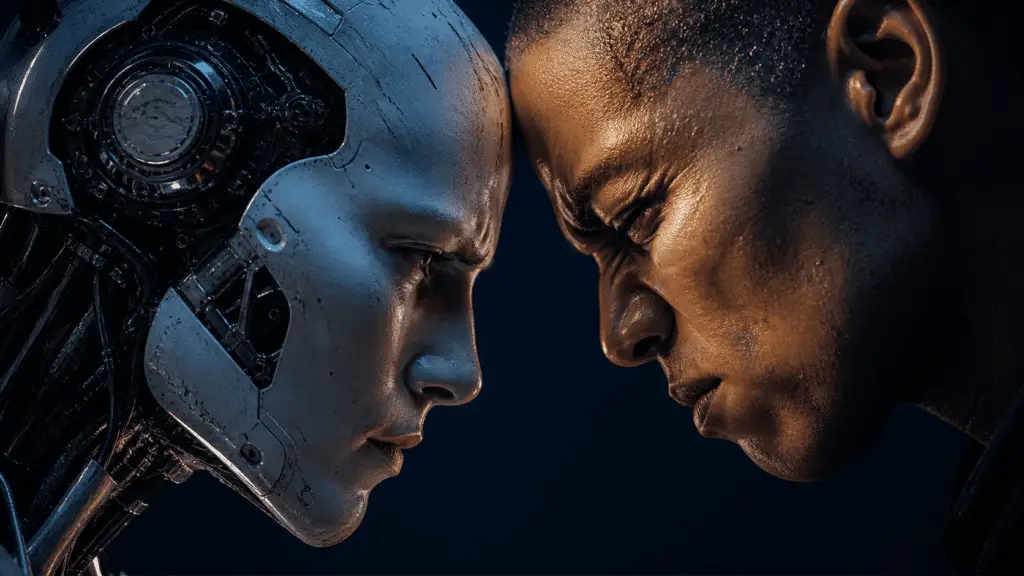
The Word Swap Nobody Made on Purpose
Watch the language in your next leadership meeting, and you will hear it. “The AI decided.” “The model recommended.” “The system flagged.” The verbs slip in without a second thought. They sound neutral. They are not.
When you describe an AI as deciding, you do something subtle to your own authority. You hand it ownership of an outcome that, in any meaningful sense, you still own. A model is software. It sorts inputs and produces outputs. That is not deciding in the way a leader decides. That is computation. The word swap is not a vocabulary problem. It is a responsibility problem.
The framing of AI decisions vs human choices matters because the language we use shapes the responsibility we accept. If the AI decided, then by quiet implication, you did not. The reasoning is convenient. The consequences are not. The hiring manager, whose AI tool screens out qualified candidates, still rejected those candidates. The CFO, whose forecasting model recommends layoffs, still signed the memo. The model is not in the room when people walk out.
This is not theoretical. Research from MIT Sloan suggests AI is far more likely to complement human work than replace it, but only if humans understand what the technology actually does and does not do. Confusion about that boundary is where the trouble starts. Once a leader genuinely believes the AI made the call, they stop asking the questions only humans can ask. “Was this fair? Was this contextual? Did this account for the things the data does not see?” Those are not decisions. They are choices.
The good news is that the fix is small and immediate. Audit your verbs. When you mean you decided, say so. When you mean the model produced an output, say that. Your authority returns the moment your language returns.
Five phrases worth flagging when they show up in your next leadership meeting:
None of those phrases are wrong, exactly. They are just imprecise in a way that matters. The model produced an output. Someone in the room turned it into a decision. The difference between those two sentences is the difference between leadership and stenography.
- “The AI decided.”
- “The model recommended.”
- “The system flagged.”
- “The algorithm chose.”
- “The data tells us.”
Every time you say AI decided when you meant you decided, you outsource a piece of your authority that nobody asked for.
Sylvie di Giusto
What an AI Decision Actually Is
Strip the marketing away, and an AI decision is something specific. It is the output of a model trained on past data, which asks a structured question and returns a ranked answer. There is no judgment in that loop. There is correlation, optimization, and inference. The model does not know what is at stake. It does not know what an outcome costs anyone. It does not know whose father lost his job, whose promotion got blocked, whose loan was denied. It returns a number. The number is good, or it is bad, but it is never owned.
This is why AI decisions vs human choices is not a contrast of speed but of weight. The model is unbothered by what comes next. It is built to be unbothered. That is a design feature. The next question runs the same way regardless of what happened with the last one.
A human in the same loop is a different organism entirely. You carry the previous outcomes with you. You remember the candidate you wanted to hire who got screened out. You remember the team member you advocated for, who you later let go. The memory is not a bug in your processing. It is the entire reason your role exists. Korn Ferry research on the leadership the AI era requires describes this exact tension. The leaders who outperform are the ones who can do what the model cannot, which is bear the weight of what gets decided.
When we describe AI as deciding, we are using a metaphor that flatters the technology and shrinks the leader. AI processes. It does not decide. The decision rests with the human who acts on the output, explains it to the team, and absorbs the fallout when the data is wrong. That last part matters more than people admit. Models do not absorb fallout. People do.
A model can rank a thousand options in a second.
It still has nothing at stake.
Sylvie di Giusto
What a Human Choice Actually Carries
A choice is not a decision dressed up. It is something different in kind. A choice carries history. It carries values. It carries the weight of the alternative you did not pick and the cost you accepted to pick this one. A choice is something you can be asked about ten years from now and still defend, or still regret. AI does not regret. It only updates.
This is the deeper layer of AI decisions vs human choices. The decision is the output. The choice is what the output costs you to enact. That cost is invisible to the model and invisible in the data. It only shows up in the human who carries it.
Think about the last hard call you made at work. Maybe you fired someone you respected? Maybe you walked away from a deal that would have padded your numbers? Maybe you backed a junior leader your peers thought was a mistake? None of those were decisions in the algorithmic sense. They were choices. They had your fingerprints on them, your reasoning, your willingness to be wrong publicly.
A recent Harvard Business Review piece on what AI cannot do makes a related point. The irreducible work of leadership is increasingly the work of judgment under uncertainty. Choices live in that territory. Decisions, when defined narrowly enough, can be made by software. Choices cannot, because choices require something the software does not have. Skin.
If your name is not on it, it is not a choice. It is a decision someone else handed you to ratify. That ratification feels like authority. It is not. It is paperwork.
If your name is not on it, it is not a choice. It is a decision someone else handed you to ratify.
Sylvie di Giusto
The Ninety-Five Percent Where Choices Live
There is a number that gets thrown around that I want you to actually sit with. The brain processes around eleven million bits of sensory information every second, and only about forty of those bits make it into conscious awareness. The rest happens below the line. That is roughly five percent conscious, ninety-five percent not.
This is not a metaphor. It is a working description of how human cognition divides labor. The conscious five percent is where you analyze contracts, weigh data, and respond to direct questions. It is the layer where AI decisions and human choices look most similar, because the conscious five percent traffics in numbers, criteria, and explicit logic. It is also the layer where it is easiest to confuse the two.
The other ninety-five percent is where leadership actually happens. It is where you read the room and adjust your tone before you speak. It is where you sense the team member who is one bad week from walking out and choose to check in before you ask for the deliverable. It is where the meaning of a comment gets parsed in two milliseconds, faster than any model can prompt itself. The cognitive scientist Tor Nørretranders described this layer in his book “The User Illusion” as the place where most of who we are actually operates. Almost everything that makes a leader trusted lives there.
AI does not have access to that layer. It cannot. The model has no body, no biography, no team it has worked with for seven years, no instinct trained by the last twenty hard conversations. It has a corpus and a prompt. The corpus is impressive. The prompt is whatever you typed. Neither of those reaches the ninety-five percent.
Which is why the framing of AI decisions vs human choices keeps mattering. The decisions can be processed in the five percent. Choices live in the ninety-five.
Most of leadership happens below the decision tree. AI cannot follow you there.
Sylvie di Giusto
Pattern Recognition Looks Like Wisdom Until It Is Not
Pattern recognition is what AI is best at. Pattern recognition is also one of the things that gets confused with wisdom most often. The two look identical from the outside. They are not the same thing.
A pattern is what worked yesterday, repeated. Wisdom is the discipline to know when yesterday should not run again. The first is computation. The second is judgment. AI excels at the first and is structurally unable to perform the second. This is not because the engineers have not solved it yet. It is because the inputs of judgment are not retrievable from data alone. They include things like dignity, fairness, what the team needs from you in this exact moment, or what the organization is becoming versus what it has been.
Most of what gets called an AI decision in business right now is pattern matching “dressed in confidence.” The model has seen ten thousand resumes that looked like A and rejected them, so it rejects yours. It has seen pricing patterns in the past two quarters and forecasts the next one as more of the same. It has read every email your team has written and predicts the next one in the same voice. None of that is wisdom. It is yesterday at speed.
The same logic applies to leadership pattern matching, which is a quieter trap. If you have been in your role long enough, you have your own internal model. It tells you what worked the last five times. It is also wrong sometimes because the next situation is not the last, and the difference between a leader and a manager often comes down to the discipline not to run the old playbook in a new game. As McKinsey noted in its work on developing human leadership in the age of AI, the leaders who outperform in this era are those who can override their own pattern recognition when the moment requires it. This is the cleanest articulation of AI decisions vs human choices in practice. AI runs the playbook. You break from it when the room needs you to.
Pattern recognition is yesterday at speed. Wisdom is the discipline to break with yesterday when the room calls for it.
Sylvie di Giusto
When the Decision Becomes a Choice
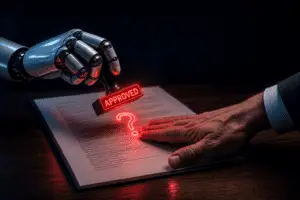
There is a precise moment when an AI decision crosses over and becomes a human choice, and most leaders walk through it without noticing. It happens when you sign your name. Not before, not after. The signature is the threshold.
Before the signature, the model has produced an output. That output is a decision in the technical sense. After the signature, you have ratified it. Now it is yours. Whatever happens next belongs to you, regardless of what the model said. This is true legally, professionally, and ethically. The model does not appear in court. You do. The model does not stand in front of the all-hands meeting. You do.
This is why leaders who lean too heavily on AI tooling without auditing the outputs expose themselves to a particular kind of failure. The model gives you a confident answer. You sign. Three months later, when the numbers do not bear out the model’s logic, the question is not “what the AI did or said.” The question is what YOU did. What you asked. What you challenged. What you signed. The accountability gap is not theoretical. It is the gap between a decision made in software and a choice made in your career.
The framing matters because it changes how leaders should approach AI tooling in practice. The right question to ask of any AI output is not “Is this the answer?” The right question is, “Am I willing to put my name on this?” If yes, sign. If no, do not. There is no halfway. The moment you act on the output, you have made a choice, even if you were telling yourself you were just deferring to the model.
This is one of the reasons my earlier piece on what happens if you rely on AI too much keeps mattering. The over-reliance is not the danger by itself. The danger is the slow erosion of the line between what the model decided and what you chose. That erosion is invisible until something goes wrong, and then it is the only thing in the room.
The minute you sign your name to it, the model’s decision becomes your choice.
Sylvie di Giusto
Why people follow you into the unknown
Read every leadership book ever written and feed it into the most sophisticated AI you can find. The model can summarize the patterns. It can recite the frameworks. What it cannot do is give people a reason to follow it through a difficult quarter, a layoff round, a strategic pivot, or a moment when the business is genuinely scared.
This is the part of AI decisions vs human choices that has nothing to do with cognition and everything to do with trust. People do not follow logic into the unknown. They follow people. Specifically, they follow the people whose choices have been consistent enough, observed enough, and accountable enough that the team has internalized a sense of the leader’s character.
When you walk into a meeting, and the team relaxes a little, that relaxation is not because they trust your decisions. They trust your choices and the way you have made them over the years. They trust that you will not throw them under the bus when it gets hard. They trust that the call you make today will be consistent with the calls you made when nobody was watching. None of that is in the data. None of that can be inferred from a transcript. It is built in the ninety-five percent over time, and it cannot be shortcut.
This is why my piece on AI and leadership keeps surfacing the same thread. The technical work of leadership is increasingly automatable. The relational work, the trust work, the choice-making work, becomes more valuable, not less. As Harvard Business Impact research on AI-First Leadership notes, the leaders who matter in this era are those who can hold the human side of the room while technology handles the data side.
AI gives you the answer. You give the room a reason to follow you… even when the answer turns out to be wrong.
AI gives you the answer. You give people a reason to follow you... even when the answer is wrong.
Sylvie di Giusto
The Efficiency Trap
There is a story most leadership teams tell themselves about AI right now, and it goes like this: “The model lets us decide faster. We are processing more options, surfacing more signals, and moving more quickly. Every meeting feels efficient. Every output looks crisp.”
Slow down for a second and ask whether anything has actually been chosen.
The efficiency trap occurs when speed becomes a substitute for substance. Teams that lean heavily on AI tooling can produce more decisions per quarter than they ever have, while making fewer real choices than they have in years. The decisions move through the dashboard. The choices, the hard ones, the ones that require the leader to take a position that might be wrong, often get deferred indefinitely. The model lets you defer with confidence, because there is always more data to gather, more options to model, or more variations to test.
This is one of the quieter failures of AI decisions vs human choices in practice. The speed of decisions creates the illusion of progress. The absence of choices is what is actually slowing the company down. EY research on people-centered AI workforces lands on a similar note. Teams that use AI well are not the ones with the most outputs. They are the ones who use the saved time to make the harder choices that the AI cannot make for them.
The test is simple. After your last big AI-assisted analysis, ask: “What choice did this analysis enable that I would not otherwise have made?” If the honest answer is “none, but I have more data,” then the analysis did not move you forward. It moved you sideways with conviction.
Efficiency is a great metric for systems. It is a terrible metric for leaders.
Sylvie di Giusto
The Choices That Built Your Career
Look back at the inflection points in your career. Not the meetings. The inflection points. The job you took that nobody else recommended. The team you joined when the consensus said the company was on the way down. The risk you walked into when the data said walk away. The relationship, professional or personal, that you fought for when the spreadsheet said it was a wash.
Every one of those was a choice. Not one of them was a decision a model could have made for you, even if the model had been perfect at the time. The reason is not that the data was wrong. The reason is that the data did not see what you saw. It did not feel what you felt. It did not know what you knew about yourself, your tolerance for the path, the version of you on the other side that would justify the discomfort.
This is what gets lost when we collapse AI decisions vs human choices into one phrase. The decisions of your career are mostly small and well-documented. They are the email replies, the project scopes, or the calendar slots. The choices are the ones that bent the trajectory. They are usually quieter, less obvious in the moment, and almost never captured in any system AI could read. The model trained on your career data could give you a useful answer about your average week. It could not have predicted the choice that defined you.
The implication is operational, not philosophical. If the choices are what mattered to your career, the choices are what matter to the people you lead. Build a habit of noticing them when they happen. Notice them in your team members, too. The decision is what appears on the dashboard. The choice is what they will tell their next leader about, ten years from now, when they explain why they are who they are.
Look at every meaningful turn in your career. Not one of them was made by a machine.
Sylvie di Giusto
The AI Question Worth Asking Now
Most of the AI questions leaders are asking right now are the wrong questions. They are versions of “what can AI do for me?” That question has an answer, and the answer keeps expanding, and the expansion is a distraction from the real work.
The right question is the inverse. “What choices will you not delegate, ever, regardless of what AI is capable of in the next five years?” Not because the AI is incompetent. Not because you do not trust the technology. But because the act of choosing, in those specific moments, is the act of being a leader. If you delegate it, you have stopped being one. The model can do the rest. You cannot let it do this.
This reframes the whole AI decisions vs human choices conversation in a useful way. You stop fighting AI on its turf, where it will eventually win on most metrics. You start defining your turf, where it cannot follow. The map is short and worth knowing.
Six choices a leader should never delegate to AI, regardless of how confident the model gets:
These are not decisions. These are the things you signed up for when you took the job. Outsource them to the model and you have outsourced the job. Keep them, and you keep what makes the role worth doing in the first place.
- The choice to fire someone, even when the data justifies it.
- The choice to back a hire who looks weak on paper.
- The choice to take a position that will be unpopular this quarter and right the next.
- The choice to apologize.
- The choice to admit the strategy was wrong before the data forces you to.
- The choice to slow down a deal because something feels off, even when no model is flagging it.
Stop asking what AI can decide for you. Start asking which choices you refuse to delegate, ever.
Sylvie di Giusto
There will be a year, soon, when the gap between what AI can decide and what humans must choose stops being a debate and becomes the most valuable line in business. The leaders who can articulate that line, hold it, and teach it to the people they lead will be worth more than they have ever been worth. The leaders who cannot will become managers of dashboards, ratifying outputs they did not produce and absorbing consequences they did not own.
AI makes decisions. Humans make choices. The wording is small. The implication is the entire job description for the next decade. The decisions will multiply. The choices will stay scarce. The scarcity is where leadership lives now. Make sure you know which one you are doing when you pick up the pen.
Frequently asked questions
What is the difference between AI decisions and human choices?
AI decisions are outputs of trained models processing data. Human choices are different in kind: they carry weight, accountability, and consequence. AI processes options. Humans decide which option to act on, in their own name, with their own stakes. Conflating the two, using "AI decided" when we mean "I decided based on AI's recommendation," is the most expensive language habit in modern leadership, because it quietly transfers responsibility to a system that cannot bear it.
Why does the distinction between AI decisions and human choices matter?
Because the language we use shapes the responsibility we accept. When leaders say "the AI decided," they unconsciously absolve themselves of accountability. But the model never appears in court, sits in front of the team, or absorbs the fallout. The human who acted on the output does. Treating AI decisions and human choices as the same thing produces leaders who lose the discipline of ownership, and that loss compounds into worse decisions across years.
How can leaders avoid outsourcing their authority to AI?
Audit your verbs. When you mean you decided, say so. When you mean the model produced an output that you then approved, say that instead. The phrase "the AI decided" is convenient and inaccurate; it absolves you of authorship that you actually still own. Replacing it with explicit ownership restores the line between AI decisions and human choices, and restores the responsibility you walked away from when you started using the convenient language.
When does an AI decision become a human choice?
The moment you sign your name. Before that, the model has produced an output. After that, you have ratified it. Whatever happens next belongs to you. This is why leaders who lean too hard on AI tools without auditing the outputs are exposing themselves to a particular failure mode. The right question to ask of any AI output is not "is this the answer" but "am I willing to put my name on this." If yes, sign. If no, do not. The signature is the threshold.
What kinds of decisions should leaders never delegate to AI?
Six categories belong on the do-not-delegate list: firing someone (even when data justifies it), backing a hire who looks weak on paper, taking an unpopular position that will be right next quarter, apologizing, admitting strategy was wrong, and slowing a deal because something feels off. These choices require something at stake for the chooser, which is exactly what AI cannot bear. AI decisions and human choices diverge most clearly in these moments, and the leaders who refuse to delegate them keep the part of leadership that actually matters.
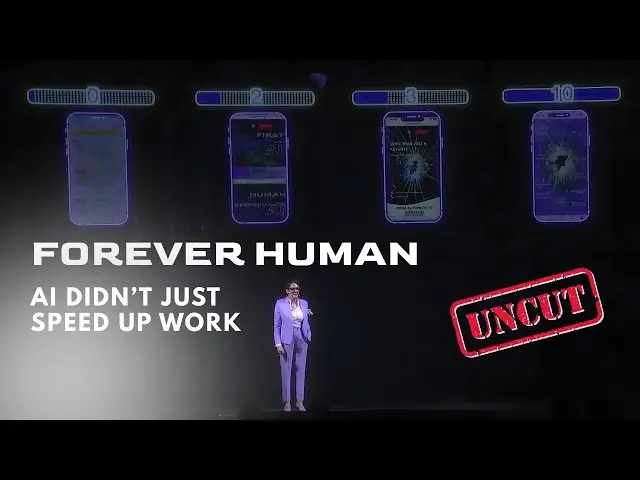
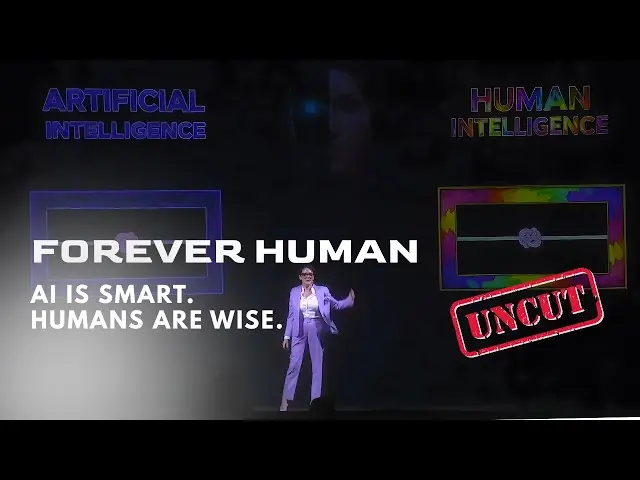
Hall of Fame keynote speaker Sylvie di Giusto explores these shifts in her keynote “Forever Human“, where audiences experience firsthand how artificial intelligence is reshaping expectations, perception, and leadership behavior. Organizations that engage with these ideas prepare their leaders not only for new technologies but for the profound human changes that come with them.
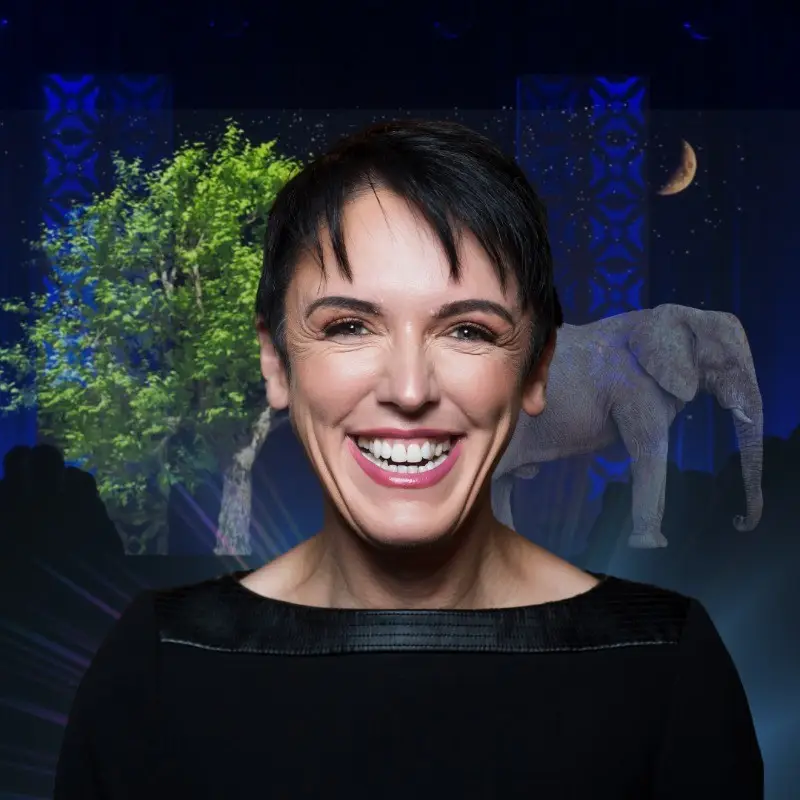
Sylvie di Giusto is an International Hall of Fame keynote speaker who has spent the last fifteen years studying how perception, presence, and decision-making actually work in the rooms where business gets done. She brings that work to global stages for executives, decision-makers, and event hosts who want their audiences to leave with something they can use the next morning. If you are planning a conference where this kind of thinking would land, she would love to talk.
If you are looking for a keynote speaker who treats your audience like the smart people they are, the conversation starts here: sylviedigiusto.com/contact.