 The most fascinating change in the conversation about AI and human behavior is not about machines becoming smarter. It is about humans becoming less patient.
For generations, waiting was unavoidable. A bank line might stretch around the corner. A package could take weeks to arrive. A phone call might involve several transfers before reaching the right person. People complained about these inconveniences, yet they accepted them as normal friction in everyday life.
Artificial intelligence has quietly removed that friction. Algorithms predict what we want before we search. Delivery services promise products within hours. AI assistants summarize long documents instantly. What once required hours of effort now takes seconds.
At first glance, this seems purely positive. Faster access to information improves productivity and opens new possibilities for innovation. Organizations move quicker. Individuals accomplish more in less time.
Yet something subtle happens beneath the surface. When speed becomes the default, patience begins to feel like a malfunction. A delayed response suddenly feels suspicious. A slow website creates frustration. A colleague who pauses before answering can seem unprepared rather than thoughtful.
AI and human behavior are interacting in ways that change expectations, not just capabilities. The problem is not speed itself. The problem emerges when speed becomes the only acceptable rhythm.
Humans evolved to think, pause, analyze, and reconsider. Those moments of reflection once happened naturally because systems were slow. Now the systems are fast. The question becomes whether human thinking can keep up without losing depth along the way.
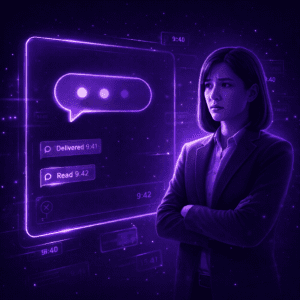 Think about it… how small digital signals shape our perception today. A typing bubble appears in a messaging app. Seconds pass. The bubble disappears. Suddenly something feels wrong. The response never arrived. A decade ago, this moment would not even exist. Messages were sent, and replies came when they came. Today, the digital environment exposes the process of communication in real time, and our brains interpret delays as problems.
Technology does not simply deliver faster responses. It reveals the timeline of communication itself. Once people can see how long something takes, they start judging that duration.
Or, a ride-share app displays the car approaching on a map. A delivery tracker shows the exact location of a package. Customer service dashboards estimate wait times down to the minute. These systems were designed to create transparency. Yet they also change expectations.
When people know how long something takes, they start expecting it to be faster next time.
This phenomenon quietly rewires our tolerance for delay. Waiting becomes less acceptable, even when the actual time difference is small. The result is a culture where seconds matter more than context. That shift is not purely technological. It is deeply behavioral.
 If someone observed the modern workplace from above, the rhythm might look something like this: Tap. Swipe. Click. Approve. Repeat. This cadence defines the new relationship between AI and human behavior in professional environments.
Artificial intelligence accelerates how quickly information moves through organizations. Reports appear instantly. Emails draft themselves. Meeting summaries arrive within seconds of the conversation ending. The efficiency is remarkable. Yet the human brain experiences something different.
The faster the information arrives, the faster people feel expected to respond. Decision cycles compress. Conversations shorten. Reflection disappears.
Leaders often notice this shift in subtle ways. Teams begin reacting instead of analyzing. Employees check dashboards constantly instead of stepping back to interpret the data. The pace feels productive. Everything moves quickly. But speed alone does not guarantee clarity.
In fact, the opposite can happen. When every decision must happen immediately, professionals stop asking deeper questions. They respond to the most recent signal rather than examining the larger pattern. AI and human behavior collide at this exact point. Artificial intelligence increases the velocity of information. Humans must still determine which information deserves attention. Without intentional pauses, the difference between “urgent” and “important” becomes harder to see.
 Artificial intelligence does not merely accelerate information. It amplifies urgency. Every digital platform delivers signals designed to capture attention. Notifications appear. Alerts flash. Dashboards update continuously. Each message suggests something important requires immediate action.
Individually, these signals are small. Collectively, they create a constant state of micro-urgency. This is one of the most powerful intersections of AI and human behavior. The human brain evolved to respond to threats and opportunities quickly. Technology now produces a steady stream of artificial signals that trigger the same reaction.
The result can be overwhelming. Professionals move from task to task without finishing the previous thought. Leaders respond to emails during meetings. Teams prioritize what appears urgent rather than what creates long-term value.
Ironically, the systems designed to improve efficiency can produce the opposite effect. When everything feels critical, nothing truly is.
Artificial intelligence provides extraordinary analytical capabilities. It can identify patterns across enormous datasets and produce insights faster than any human team could manage. Yet interpretation remains human. Without thoughtful leadership, organizations risk becoming reactive environments where speed replaces strategy. Understanding the relationship between AI and human behavior helps leaders recognize this pattern before it becomes the default culture.
 The presence of artificial intelligence does not eliminate the need for leadership. It makes leadership more important. AI can generate answers quickly. It cannot determine which answers deserve attention. That responsibility remains human.
This distinction sits at the heart of the relationship between AI and human behavior in modern organizations. A leader’s role is not simply to move quickly. It is to decide when speed helps and when reflection matters more.
Consider moments of uncertainty. A crisis unfolds. Data floods the screen. Algorithms generate predictions and recommendations. The temptation is to act immediately. Yet the most effective leaders often do something different. They pause.
Not because they lack information. Because they want to understand what the information means. This pause may last only a few seconds. Yet it creates space for judgment, context, and perspective.
Artificial intelligence can calculate probabilities. It cannot read the emotional temperature of a team or recognize when people need reassurance rather than instruction. These subtle human signals remain essential for organizational stability.
When leaders understand the connection between AI and human behavior, they recognize that calm thinking becomes a strategic advantage. Speed will always exist. Wisdom determines when to slow down.
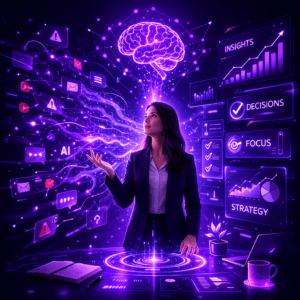 The solution to accelerating technology is not rejecting it. Artificial intelligence provides extraordinary capabilities that improve productivity, innovation, and problem-solving. The challenge is maintaining human intentionality alongside those capabilities. Understanding AI and human behavior allows individuals and organizations to design healthier decision environments.
Several practices help restore balance:
First, professionals benefit from creating moments of deliberate pause during complex decisions. Even a brief reflection period can prevent reactive choices driven by urgency rather than insight.
Second, leaders can protect time for deep thinking. Strategic work rarely happens between notifications. It requires uninterrupted attention.
Third, teams can shift conversations from immediate reaction to thoughtful interpretation. Instead of asking only what happened, they ask what it means.
Finally, organizations can encourage leadership styles that prioritize clarity over speed.
Artificial intelligence excels at delivering information instantly. Humans excel at interpreting that information within a broader context. The combination creates remarkable potential. Yet that potential only appears when technology and human judgment operate together rather than competing for attention.