Which AI layers already run on the factory floor?
Most board conversations about AI in manufacturing still talk about it in the future tense. That is charming, and wrong. Four layers are already shipping at most major manufacturers:
- Predictive maintenance. Sensor data feeds anomaly models that flag asset risk hours or days before traditional monitoring would.
- Vision inspection. Cameras trained on defect libraries catch surface, dimensional and assembly issues at line speed.
- Production scheduling. Optimizers build in minutes the schedules planners used to spend a week on, weighing changeovers, materials and demand at once.
- Demand forecasting. Models read seasonality, promotions and outside signals together in ways no planner ever had time for.
What interests me is not that these exist. It is how unevenly they are spread. Some manufacturers run all four. Others run one and talk about the other three at conferences. That gap will show up in cost structure within three years and in customer retention within five. And the leadership team that does not know which layers already run inside its own plants will find out the way nobody wants to: on a competitor’s earnings call.
AI in your plant is not a pilot. It is a present tense you have not audited yet.
What did predictive maintenance really teach us?
Predictive maintenance is where AI in manufacturing has gone furthest, so it is the best preview of what the other layers will look like when they grow up. The pattern is simple. Sensors feed a model, the model flags risk earlier than the old rules did, the team fixes things before they fail and unplanned downtime drops. Most facilities see the return within the first quarter.
The real lesson, though, is about people. Every plant has that one senior technician who knows which machine sulks in humidity and which one starts complaining a week before it breaks. That person used to be the institutional memory. Now they work next to software that has read every sensor reading from every asset on every shift.
Their value did not disappear. It concentrated. They became the person who decides whether the flag is real, whether the recommended fix suits that machine’s history and whether the problem is something the model was never trained to see. The plants that paired these people with the AI got the gains the vendor promised. The plants that saw a headcount opportunity discovered, expensively, that the senior judgment was what kept the system honest.
The model reads the sensors. Your best technician reads the model. Keep both.
How is vision inspection changing quality work?
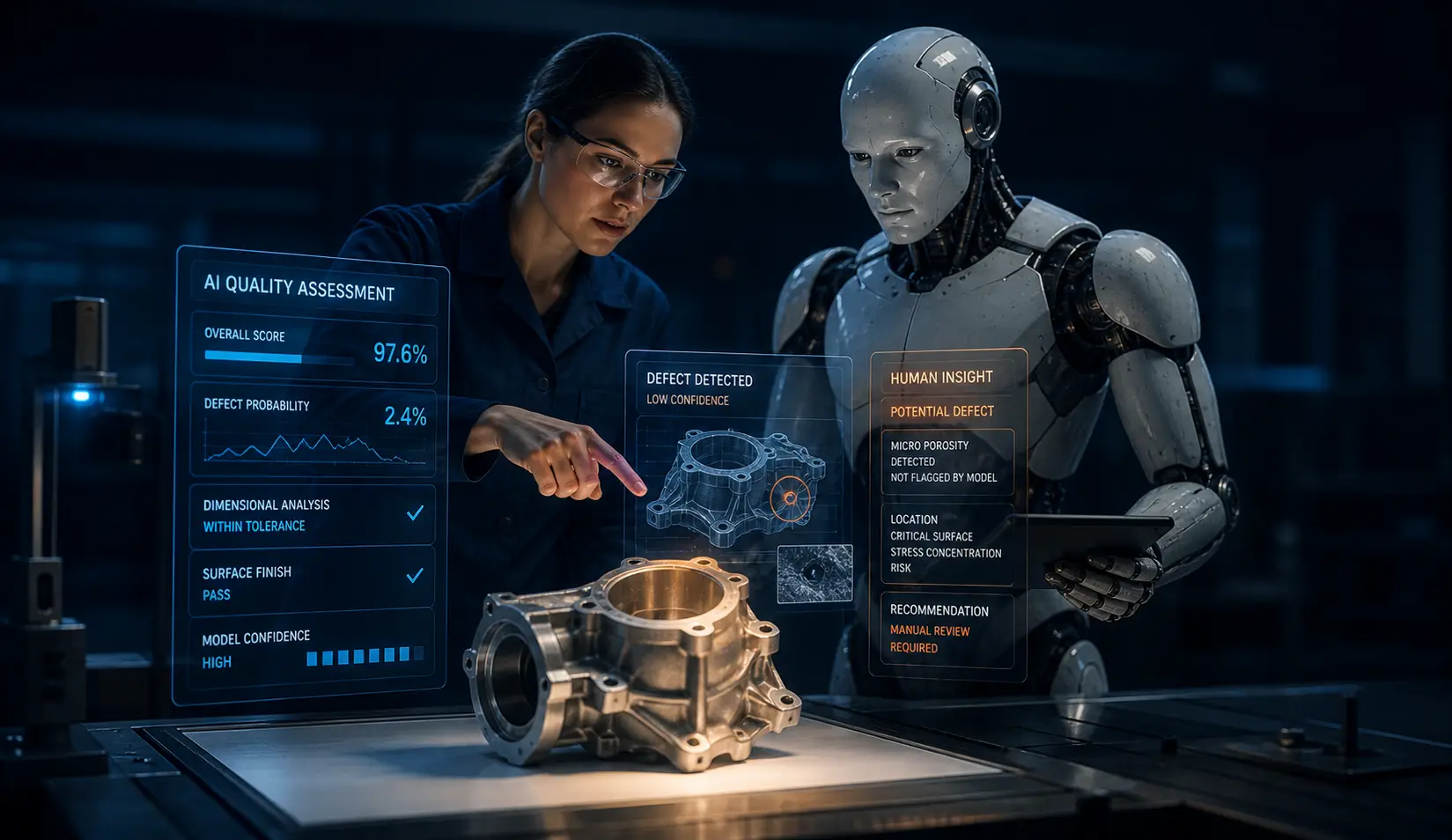
Vision inspection catches scratches, dimensional drift, missing assembly steps and finish flaws at line speed, often more reliably than a skilled inspector at the end of a twelve-hour shift. I find that genuinely impressive. The routine pass now belongs to the camera.
But the inspector did not vanish. Their job moved to the edge cases: the parts the system marks as ambiguous, the defects that match nothing in the library and the parts that technically pass but should not ship, because something two steps downstream is going to fail. Each of those is a judgment call. Each one increasingly separates the inspector who is paid above the floor from the one the process quietly routes around.
Payroll did not necessarily shrink. The mix changed. Routine positions consolidated. Judgment positions became more valuable. If that sounds familiar, it is because it is the same story in almost every industry I speak to, just with safety glasses on.
The camera catches the defect. Only a human catches the part that should not ship anyway.
Why does the human investment keep losing the budget fight?
Here is something I learned in two decades of HR: budgets do not reveal strategy. They reveal what can be measured by next quarter. Most manufacturers are running an investment imbalance that is invisible from the inside, because every individual line item looks perfectly reasonable.
AI tooling gets approved, because vendors quantify the gains for you. Robotics gets approved, because procurement can measure throughput. Programs on robotics integration, quality systems thinking or adaptability do not survive that frame, because their return is invisible for about eighteen months. The operator who reads two industrial automation publications a quarter does not ship one extra part that quarter.
Five years from now, the manufacturers that funded both sides will look very different from the ones that funded only the stack. The second group will own exactly the same tools as their competitors, and they will be competing on the one thing nobody wants to compete on: price.
Everyone can buy the same AI. Nobody can buy your people’s judgment off a shelf.
Where is the operator role concentrating?
If you want to know where human value is heading in manufacturing, do not read the strategy deck. Watch where your senior operators actually spend their day. A pattern shows up quickly:
- safety calls in situations the procedure never anticipated
- root cause analysis when a problem spans engineering, supplier and floor
- shift handovers that turn what one team saw into what the next team must act on
- mentoring new hires whom no AI tool can teach to think
The model cannot occupy any of these, because each depends on context that is not in the training data. The safety call relies on having seen something similar on a different machine ten years ago. The handover is a translation between two groups of tired humans. The mentoring requires spotting a gap the junior operator does not even know they have.
Manufacturers that build career paths rewarding this work are quietly keeping the senior operators their competitors keep losing.
The operator is not disappearing. The operator is becoming the part of the plant you cannot automate.
Why can the algorithm not solve supplier quality?
Supplier quality is my favorite test of what AI in manufacturing cannot do. A defect on your line came from a component your supplier made, from a material lot a sub-supplier delivered, against a specification a fourth company wrote. The model watching your line sees exactly one of those four parties.
Fixing it is human work, because it means crossing walls the AI has no access to. The senior quality engineer who can get the supplier’s quality lead and the sub-supplier’s process engineer on the same call within the hour, and figure out where the variation really came from, is doing something no model will do for a very long time. The reason is not technical. The data sits behind contracts, NDAs and company firewalls. And the people on the other end of the call only open up to someone they trust.
That is where the most expensive failures hide. Which makes it exactly where your most valuable people should be standing.
The algorithm stops at your property line. Your quality problems do not.
What will set leading manufacturers apart by 2030?
The manufacturers I would bet on are doing three things at once. They finish deploying all four production layers, so their AI stack matches the leading edge. They build the human layer on top, through deliberate programs on safety judgment, cross-tier quality, robotics integration and high-mix adaptability. And they redesign the operator career ladder so that judgment, systems thinking and mentoring are what get recognized and promoted.
Skip one and you land in one of two weak spots. Either you are an efficient operator of a stack everyone else also owns, or you are a brilliant team sitting on top of an underbuilt stack, losing on cost. Both lose over five years to the manufacturer that treated both layers as one strategy.
And then there is that plant director, still sitting with the layout recommendation. As AI starts proposing layouts, material substitutions and supply chain changes faster than teams can evaluate them, someone has to decide what the system is allowed to optimize for. That is the future of manufacturing. Less about running the line. More about deciding what should exist at all.
When the machine can design the factory, the leader’s job is deciding what is worth building.

Forever Human
The model can redesign the line overnight. It cannot decide what is good enough to execute. My book Forever Human is about that kind of judgment, and why it becomes more valuable the smarter the tools get.