
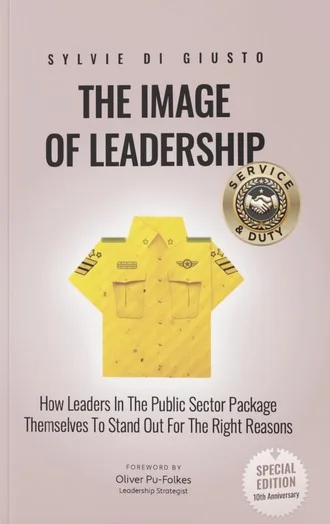
The Image of Leadership in Service & Duty cover
The Badge of Influence

The Image of Leadership in Service & Duty

Public trust is built one interaction at a time.
Special edition · foreword by Oliver Pu-Folkes

Order on Amazon

Authority is given. Trust has to be earned.

The Image of Leadership in Service & Duty shows military officers, law enforcement commanders, emergency services coordinators and government executives how their teams, senior leaders and the public decide, within moments, whether to trust them. It translates Sylvie di Giusto’s ABCDEs of professional identity into the realities of public service: prescribed uniforms and unwritten ones, chain of command and community forums, public records laws and the scrutiny that comes with serving the taxpayer.

I strongly recommend to my colleagues, especially in the field of public safety and law enforcement, that this special edition should be required reading for all committed government agents.
Oliver Pu-FolkesChief Investigator, New York State Attorney General, foreword to this edition

Who this edition is for

  • A federal law enforcement professional competing for a regional operations director role
  • A military leader moving from active field roles into administrative leadership
  • An emergency services coordinator or first responder leading teams through crises
  • A government executive representing an agency before legislators, the press and the public
  • A city planner or policy advisor who wears no uniform but still answers to an unwritten one
  • A supervisor who must address uniform lapses, hygiene or social media posts with team members

The five signals, for Public Sector

AAppearanceWhat people see first, and keep seeing.
BBehaviorHow you act in the room, and when no one is watching.
CCommunicationThe verbal and nonverbal messages you send.
DDigitalWho you are online before anyone meets you.
EEnvironmentThe spaces and people you surround yourself with.
The opening story

Evan, Matt and the Deputy Director

Two professionals, Evan and Matt, are competing for the position of regional operations director at a federal law enforcement agency, a critical role overseeing multiagency collaboration and high-stakes field operations. On paper their qualifications are nearly identical. Both are greeted in the reception area of the agency’s regional headquarters by Christine, the Deputy Director of Federal Operations and one of the highest-ranking officials in the agency. Both receive the same firm handshake and walk the same corridors past special agents and intelligence analysts. Yet the two interviews could not unfold more differently. Evan feels out of sync and is shown the door after twenty minutes. Matt’s conversation runs an hour, draws in a senior advisor on technology integration, and ends with an invitation to a follow-up meeting. At the leadership meeting the next day, Christine calls one candidate qualified but lacking. The other: “Impressive.” Equivalent credentials, opposite outcomes. So what did Christine see before either interview even began?

Chapter 1 tells you what happened next.

Inside the book

  1. Seven SecondsThrough the story of Evan and Matt, this chapter shows how team members, senior leaders and constituents size up a leader within moments, and what a poor professional identity can cost, from diminished credibility to public image risks amplified by the media.
  2. Your Professional IdentityWhy the reputation of any government body, public safety department or regulatory commission rests on its representatives. Introduces the ABCDEs (appearance, behavior, communication, digital footprint, environment), internal and external consistency, and four levels of visibility, from invisible to referrable.
  3. Leaders Look ConfidentHow confidence about your body, age, gender identity and style shapes authority in hierarchical environments, including fitness standards in uniformed roles, the height premium in politics and the military, younger leaders facing seniority, and women leading in law enforcement and national defense.
  4. Leaders Look AuthenticAuthenticity is not “you do you.” Military codes of conduct and constant public scrutiny set the context, and seven keyword styles, from the Explorer as a community policing officer to the Traditionalist as a command sergeant major, help you find yours.
  5. Leaders Look ProfessionalFrom the prescribed uniforms of police officers, firefighters, paramedics and correctional officers to the unwritten uniform of policy advisors and city planners, with ten typical team reactions to uniform policy and the situational awareness a disaster site demands.
  6. Leaders Look RespectfulRespect as a boomerang: respect for yourself, your team, your agency, those who lead you and your constituents, and what to do when it is not returned. Includes damage control when a moment captured on video escalates in the court of public opinion.
  7. Leaders Look ControlledSelf-awareness, self-care and self-promotion as disciplines, a set of questions to prepare for a press briefing, community meeting or legislative hearing, and why your ethics, your words and even the car you drive face taxpayer-level scrutiny.
  8. Leadership in a Digital LandscapeHow to know, repair, own, control and monitor your e-shadow, plus the considerations unique to public service: emails that may become public records, possible limits on personal social media, likes read as endorsements, cyber threats and restrictions on self-promotion.
  9. Leaders Lead by ExampleYour professional identity as the compass for your team, the excuses you will hear (the weather, the budget, “we’re a small-town municipal office”), and how to prepare for sensitive conversations about attire, hygiene or social media posts, even with colleagues outside your authority.
  10. Moving ForwardThe potato chip on the cover becomes a metaphor for packaging and expectation, and a closing case for a consistent professional identity that keeps you at eye level with your team members, senior leaders and constituents.

Only in this edition

The invisible filters of public trust

Science knows roughly 185 unconscious biases, and every constituent, team member and senior official filters you through them. Confirmation bias seeks proof of what people already believe about government. Anchoring bias lets one early detail shape everything after it. The horn effect turns a single perceived flaw, a momentary pause before a briefing question or a disengaged moment on a field visit, into a verdict on your leadership and your agency. Sylvie shows how these silent storytellers work against leaders in service and duty, and how to make them work in your favor.

Respected, not liked: the sustained imprint

At a leadership seminar in Europe, the trainers were horses. One group won the horse over with confidence; the other brought kindness, petting and treats, and the horse stopped following once the treats ran out. Yet the winning group lost its hold the moment its conduct became unpredictable. Sylvie’s lessons for public service: respect is the foundation and being liked is a bonus, and predictability and consistency engender trust. Because you are observed in unguarded moments too, from your desk to the grocery store aisle, the imprint must hold everywhere.

Good is the baseline in service and duty

In agencies, departments and units, excellence is the new norm and “good” is simply what the public expects. Sylvie uses the game of Tetris to make the point: the piece that fits perfectly completes a line and disappears. A triumph in the game, a warning in your public service career. Leaders who rise become the piece that fits and also starts a reaction, challenging the status quo and creating a new path toward public trust, operational efficiency and community engagement. The book shows how to stand out for the right reasons.

One message, from the agency to the town hall

Your appearance, behavior, communication, digital footprint and environment must all sing the same tune, inside your agency and before legislative committees, press conferences, town halls and local residents. Presenting yourself as a steward of public service while signaling self-interest or partiality sends mixed messages. Sylvie also shows how one team member can crack the message, through conduct at a public event or controversial posts online, because the public rarely separates personal from professional when judging public servants. The book explains why consistency must permeate the entire team.

Advocating for your work within the rules

If you don’t advocate for your achievements, who will? Leaders in service and duty face a sharper version of the dilemma: alongside imposter syndrome and the fear of seeming self-important, sharing achievements can look like leveraging public office for personal gain. Sylvie reframes self-promotion as controlling your narrative, advocating for the value you bring and raising the profile of your team’s efforts through institutional channels and external recognition. As the CEO of your own career, she argues, you also choose progress over perfection.

The conversations leaders avoid

Sooner or later you will need to talk with a team member about something uncomfortable: personal hygiene, emotions mismanaged in interactions, an unfortunate social media post, disrespect toward the public. Many leaders delay it to protect team harmony. Sylvie offers a clear path: prepare with precision, consult HR or legal on sensitive issues, and never hold the talk in a municipal building’s public area or during peak operational hours. Open with specific praise, use neutral language, expect pushback, and keep the focus on growth, not blame.

Questions readers ask

Why do hardworking public servants get passed over for leadership roles?

Being known for good work is not enough. The book describes four visibility levels: invisible, common, unique and referrable. Dedicated public servants often stall at being common: recognized for managing their team well, but seen as dependable and interchangeable. Promotions tend to go to leaders whose strengths are advocated by others in high-level meetings. Getting there takes intentional work on your whole professional identity. Chapter 2, Your Professional Identity, covers this in depth.

How do public sector leaders earn the trust of their teams and the public?

Through consistency. Your appearance, behavior, communication, digital footprint and environment must tell the same story, inside your agency and in public. Presenting yourself as a steward of public service while signaling self-interest or partiality sends mixed messages. The challenge extends to your whole team, because the public rarely distinguishes between a public servant's personal and professional conduct. Chapter 2, Your Professional Identity, explains how internal and external consistency builds lasting credibility.

What should a public official wear to a disaster site or emergency response?

Practicality outranks formality. The book contrasts a leader who arrives at a flood-affected site in an immaculate suit, which reads as tone-deaf and out of touch, with an official in sturdy boots and high-visibility gear who signals readiness and solidarity with the team on the ground. For leaders in prescribed uniforms, situational awareness means wearing the uniform with the right care for the context. Chapter 5, Leaders Look Professional, covers this in depth.

Why is a public sector leader's conduct held to a higher standard?

Every decision and interaction is measured not only inside your agency but by the community at large. Ethics and morals form the cornerstone of leadership in this sector, and any perceived lapse in integrity can erode the credibility of the entire agency. Your team looks for composure in adversity, clear directives and sound judgment; a gap between presentation and action erodes trust. Chapter 7, Leaders Look Controlled, covers this in depth.

How can government leaders keep their words from being taken out of context?

In emotional, high-stakes settings, recording devices and social media can carry a poorly phrased remark to audiences far removed from the original context. The book urges leaders to choose words that inspire rather than merely inform, to explain rather than simply direct, and to listen in order to understand. Clarity and empathy ensure you are heard and understood. Chapter 7, Leaders Look Controlled, covers this in depth.

Can a like or share on social media affect a public servant's career?

Leaders in service and duty are held to a higher standard of neutrality, so even a like, a repost or a shared article can be read as an endorsement of ideas, biases or affiliations. Personal accounts will be seen through a professional lens, some roles restrict personal profiles altogether, and your emails may become public records. Search your own name regularly. Chapter 8, Leadership in a Digital Landscape, covers this in depth.

Does a government leader's office, vehicle or circle of associates affect public trust?

It does. Many members of the public view office spaces, resources and even vehicles as tied to their tax contributions, which raises expectations of accountability and restraint. A luxury car can suggest extravagance, while an organized, functional office signals professionalism and attention to detail. The people you associate with reflect on you as well, so your personal and professional worlds should complement rather than conflict. Chapter 7, Leaders Look Controlled, covers this in depth.

Can I order copies for my team or conference?

Yes. Preferred pricing is available for groups, conferences and client gifts, and signed copies are available on request. Many organizations pair the book with The Power of Choice keynote, which is built on it.

Is this edition available as an ebook?

Yes. The Image of Leadership in Service & Duty is available in paperback and as a Kindle ebook on Amazon.

Around the clock

Still have questions? Ask Edna.

Edna

Ready to make your people impossible to replace?