
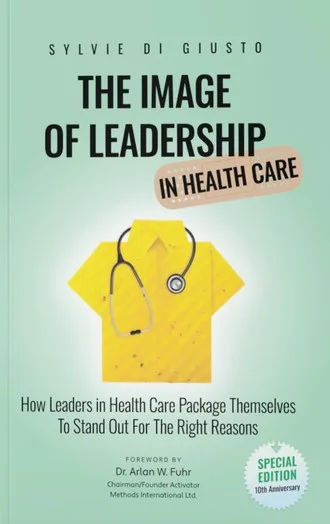
The Image of Leadership in Health Care cover
The Anatomy of Influence

The Image of Leadership in Health Care

Patients trust what they see before they understand what you know.
Special edition · foreword by Dr. Arlan W. Fuhr

Order on Amazon

Your bedside manner starts before the bedside.

The Image of Leadership in Health Care shows clinicians, administrators and practice owners how patients, colleagues and hiring committees decide, within seconds, whether to place their trust in you, and possibly their life. It translates Sylvie di Giusto’s professional imprint into the realities of health care: scrubs and white coats, private practice and the executive suite, the telehealth screen and the waiting room where families look you up online.

The examples in this book will help you get the job you want and not be stuck in the job you have.
Dr. Arlan W. FuhrChairman and Founder, Activator Methods International, foreword to this edition

Who this edition is for

  • A department head aiming for an executive director position within a hospital
  • A senior nurse considering a leap into health care administration
  • A specialist doctor with sights set on a chairperson role on a medical board
  • A practitioner opening a first practice or growing an existing one
  • A health care executive setting the professional standard for an entire institution
  • A team leader who must address attire, hygiene or social media issues with staff

The five signals, for Health Care

AAppearanceWhat people see first, and keep seeing.
BBehaviorHow you act in the room, and when no one is watching.
CCommunicationThe verbal and nonverbal messages you send.
DDigitalWho you are online before anyone meets you.
EEnvironmentThe spaces and people you surround yourself with.
The opening story

Charlie, Roger and Dr. Judy

Two physicians are competing for the role of chief medical officer at a prestigious hospital. Their names are Charlie and Roger, and on paper they are identical: same qualifications, same resumé. Both are greeted by Dr. Judy, the hospital’s CEO and president, in the administrative wing. Both walk the same bustling corridor to her office. Yet the two interviews could not unfold more differently. Charlie feels the opportunity slipping away like water through his fingers and is ushered out after twenty minutes. Roger is offered a coffee, drawn into a conversation about a current hospital initiative, introduced to the clinical director, and invited back the following week. At the medical staff meeting the next day, Dr. Judy’s verdict on one candidate is a flat no. On the other: “Very strong.” Identical credentials, opposite outcomes. So what did Dr. Judy see in the reception area that neither resumé could tell her?

Chapter 1 tells you what happened next.

Inside the book

  1. Seven SecondsThrough the story of Charlie and Roger, this chapter shows how patients, caregivers and hiring committees decide within moments whether to trust you, and what a poor professional imprint can cost, from patient satisfaction to viral social media fallout.
  2. Your Professional ImprintWhy everyone, from the receptionist at a family clinic to the lead surgeon at a top hospital, represents the institution. Includes a patient’s walk through a practice and introduces the ABCDEs: appearance, behavior, communication, digital footprint and environment.
  3. Leaders Look ConfidentHow confidence about your body, age, gender and style shapes your presence on the ward and in the boardroom, including research on white coats and enclothed cognition and the gender dynamics of specialties such as obstetrics and surgery.
  4. Leaders Look AuthenticSeven keyword styles help you build a signature look that is genuinely yours, illustrated by how a hospital nurse and a chiropractor in private practice can both embody the keyword “care” in very different attire.
  5. Leaders Look ProfessionalThe spectrum of health care attire, from scrubs to suits: uniforms as emblems of trust and hygiene, the choice to wear or skip the white coat, formal attire for board meetings and negotiations, and dressing for crises and community events.
  6. Leaders Look RespectfulRespectful attire as a visual pledge to patients at their most fragile: the physician’s impeccable presentation, the nurse’s pristine scrubs, the pediatrician’s cheerful tie, and an appearance that honors diverse patient populations and your institution’s legacy.
  7. Leaders Look ControlledKeeping control in an emotionally charged industry: self-awareness, self-care and discipline, dressing for the predictable and the unpredictable, and how your behavior during a code blue, your words when delivering a diagnosis, and even your car shape trust.
  8. Leadership in a Digital LandscapeYour LinkedIn profile, hospital bio and patient reviews often reach people before you do. This chapter covers telehealth presence, written communication, name twins and how to know, repair, own, control and monitor your digital footprint.
  9. Leaders Lead by ExampleWhy your staff follow what you do rather than what the dress code says, and how to hold honest conversations about attire, hygiene, emotions or social media posts in a hospital or practice without damaging the relationship.
  10. Moving ForwardThe potato chip on the cover becomes a metaphor for professional packaging, and for why patients and families seek comfort in traditional symbols of medical authority while still accepting a leader’s human imperfections.

Only in this edition

The Invisible Filters in the Waiting Room

A patient waits unacknowledged, notices a crumpled paper under a worn chair, then meets a doctor who rushes in without an introduction. Not a word about care has been spoken, yet a verdict is already forming. Sylvie unpacks the unconscious biases behind it, from confirmation bias and anchoring to the horn effect, and shows how they can turn a skilled practice into a “subpar” one in a patient’s mind. She also shows how health care leaders can make these same filters work in their favor, without manipulating anyone.

The Sustained Imprint at the Bedside

In a leadership seminar run with horses, one group commanded respect without a word, while the group armed with treats and kindness was ignored. Then the first group grew inconsistent, and the horse stopped following. The lesson: predictability and consistency are the cornerstone of leadership, and respect outlasts being liked. Sylvie applies it from the emergency room to the recovery ward and the private practice, where steady composure and reliable follow-up care turn medical transactions into compassionate care and first-time patients into lifelong ones.

Good Is the Baseline in Health Care

In a field where the stakes are as high as human lives, good doesn’t cut it anymore. It is the expectation. Sylvie uses the game of Tetris to make the point: the piece that fits perfectly completes a line, and the line disappears. Health care leaders who stand out are the piece that starts a reaction, challenges the status quo and creates a new path for others to follow. The book explains why standing out for its own sake is a terrible idea, and what standing out for the right reasons truly requires.

One Message, From the Ward to the Community

Your appearance, behavior, communication, digital footprint and environment must sing the same tune, inside your institution and beyond its doors. Internally, that means clinical settings, multidisciplinary teams and consultations with colleagues. Externally, it means patients, families, regulatory agencies and community partners. Because health care is a team-based endeavor, the harder challenge is consistency among your staff, from infection control protocols and shared spaces to encounters at the local market and personal social media posts. Every inconsistency reflects on the institution, and ultimately on you.

The CEO of Your Health Care Career

Self-promotion is often misunderstood as bragging or boasting. Sylvie reframes it as appropriately communicating your achievements and the value you bring to your role and institution: making your contributions visible, not for applause, but to inspire others and advocate for your team’s work. Paired with self-improvement, it becomes a proactive discipline of setting clear goals, seeking feedback, pursuing further education or certifications and engaging in professional networks. As the CEO of your own career, you cannot expect others to recognize what you never make visible.

Hard Conversations on a Caring Team

Caregivers instinctively avoid causing discomfort, which is exactly why sensitive conversations with staff get postponed: hygiene issues, mismanaged emotions, unfortunate social media posts, neglected workspaces, disrespect toward stakeholders. Sylvie offers a clear approach. Prepare with precision, consult human resources or a legal advisor when needed, and never talk in a hallway or just before a stressful procedure. Open with specific praise, such as the quick thinking that averted a crisis, use neutral language, and keep the focus on professional growth and patient care, not on personal criticism.

Questions readers ask

How do I build executive presence as a health care leader?

Executive presence, professional image and personal branding all describe the same thing: how you present and define yourself in your career. The book frames it as your professional imprint, the sum of your choices in five areas: appearance, behavior, communication, digital footprint and environment. Presence grows when all five align, both inside your institution and with patients, families and community partners. Chapter 2, Your Professional Imprint, covers this in depth.

Why do qualified candidates lose out on health care leadership roles?

Because credentials rarely decide alone. The book follows two candidates for chief medical officer with identical résumés, yet only one is seen as a leader. Hiring committees cannot cite presentation as a reason, but posture, attentiveness, attire and even a candidate's online persona shape how ready someone seems. An inconsistent professional imprint can cost you the respect of peers and lead to missed promotions. Chapter 1, Seven Seconds, covers this in depth.

Do health care leaders still need to dress formally?

It depends on the setting. Scrubs, the white coat and business casual each have their place in health care. In executive board meetings, fundraising events and contract negotiations, however, formal attire is still expected. This is not about cost or a bespoke wardrobe; it is about the precision with which you choose and wear your attire as you climb the hierarchy. Chapter 5, Leaders Look Professional, covers this in depth.

How should a health care leader behave under pressure?

In health care, crises are a matter of when, not if, and your behavior carries as much weight as your appearance. During a code blue, a calm demeanor, clear commands and swift decisions demonstrate the control your presentation promises. Conduct that contradicts your look turns your appearance into an empty shell. The book's standard: be the calm in the chaos and the clarity in confusion. Chapter 7, Leaders Look Controlled, covers this in depth.

How do I have a difficult conversation with a member of my staff?

Prepare first: define the issue precisely, weigh its consequences for patients and the team, and consult human resources or a legal advisor when the topic is sensitive. Choose a private space and a calm moment, never a hallway or the minutes before a procedure. Open with specific praise, use neutral language based on what you observed yourself, and be explicit about the change you expect. Chapter 9, Leaders Lead by Example, covers this in depth.

What do patients find when they search for their doctor online?

Often more than you expect, and sometimes while you are treating their loved one. Search engines act as the new background check. The book recommends searching your name, titles, practice and institution in a private browser window, reviewing your profiles, photos and connections, and responding promptly and constructively to patient reviews. Credentials such as MD or RN help make your name unmistakable. Chapter 8, Leadership in a Digital Landscape, covers this in depth.

Does my car or my office really affect how patients see me?

It can. The book points out that the car you drive, the books on your practice's shelves and the people you associate with all color how others perceive you, especially in emotionally charged moments. An unkempt car may suggest a practice that is not current; a flashy sports car may prompt patients to question the cost of their care. Chapter 7, Leaders Look Controlled, covers this in depth.

Can I order copies for my team or conference?

Yes. Preferred pricing is available for groups, conferences and client gifts, and signed copies are available on request. Many organizations pair the book with The Power of Choice keynote, which is built on it.

Is this edition available as an ebook?

Yes. The Image of Leadership in Health Care is available in paperback and as a Kindle ebook on Amazon.

Around the clock

Still have questions? Ask Edna.

Edna

Ready to make your people impossible to replace?