
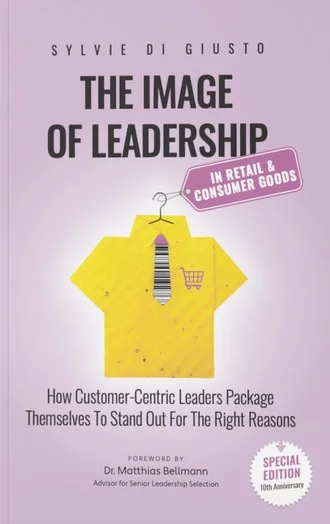
The Image of Leadership in Retail & Consumer Goods cover
The Marketplace of Influence

The Image of Leadership in Retail & Consumer Goods

Customers read your brand through your people.
Special edition · foreword by Dr. Matthias Bellmann

Order on Amazon

Your people are your most visible brand.

This edition brings The Image of Leadership onto the sales floor, into the distribution center and across the e-commerce dashboard. It shows customer-centric leaders how their presence, from the uniform their teams wear to the profile customers find online, shapes whether people trust them, follow them and choose their brand. It is also the most personal edition Sylvie has written, a homage to the industry where her own leadership journey began.

Sylvie di Giusto will show you a proven range of actions you can take to effectively counter a distorted categorization of your professional identity, but also how to achieve the impact you want and deserve.
Dr. Matthias BellmannAdvisor for Senior Leadership Selection, foreword to this edition

Who this edition is for

  • A store director responsible for a flagship location and the team that represents the brand every day
  • A district manager who leads multiple stores and is judged in every store walkthrough and virtual meeting
  • A visual merchandiser or brand designer moving into a leadership role
  • An e-commerce strategist or customer experience leader whose presence is mostly digital
  • A supply chain or logistics leader who moves between corporate offices and distribution centers
  • A store associate or sales manager preparing for a first promotion into management

The five signals, for Retail

AAppearanceWhat people see first, and keep seeing.
BBehaviorHow you act in the room, and when no one is watching.
CCommunicationThe verbal and nonverbal messages you send.
DDigitalWho you are online before anyone meets you.
EEnvironmentThe spaces and people you surround yourself with.
The opening story

Evan, Matt and the Regional Sales Director Role

Two candidates with nearly identical résumés arrive at the corporate headquarters of a prestigious retail brand. Both want the same position: regional sales director, the role that oversees flagship stores, drives sales performance and shapes customer engagement. Both are greeted in reception by Evelyn, the chief retail officer, with the same firm handshake. They walk the same corridors, past visual merchandisers preparing seasonal campaigns and sales managers reviewing performance dashboards, and they face the same precise questions. Evan leaves after twenty minutes with a polite promise that the brand will be in touch. Matt stays for an hour, meets the Director of Customer Analytics and is invited back. The next day, Evelyn tells her leadership team that one candidate is qualified and the other would be an excellent fit. If their credentials were the same, what did Evelyn see in the reception area before either man said a word?

Chapter 1 tells you what happened next.

Inside the book

  1. Seven SecondsHow quickly team members, senior leaders and customers decide whether to trust you, told through Evan and Matt’s interview, and why an industry built on storefronts, packaging and displays judges its leaders just as visually.
  2. Your Professional IdentityWhy Sylvie prefers professional identity over executive presence, how leaders shape the reputation of global retailers, boutiques and direct-to-consumer brands, and an introduction to the ABCDEs: appearance, behavior, communication, digital footprint and environment.
  3. Leaders Look ConfidentThe saboteurs of confidence that retail leaders know well: comparing seasonal results, a rejected store layout proposal, imposter syndrome measured in sales figures, and the pressure of one poorly managed sales event or inventory shortfall.
  4. Leaders Look AuthenticThe chameleon or the peacock: how to stay true to yourself in customer-focused environments, and how seven keyword styles help you choose a look that reflects who you are as a leader.
  5. Leaders Look ProfessionalDress codes, uniforms and unwritten standards in retail and consumer goods, from branded flagship uniforms and warehouse safety gear to the silent uniform of luxury retail, visual merchandising and logistics leadership.
  6. Leaders Look RespectfulWhy you are the CEO of your own professional identity, what your presence signals to teams, customers and the brand, and how to handle mistakes when a customer can post or stream an incident from the store floor.
  7. Leaders Look ControlledSelf-awareness, self-care and self-promotion for leaders facing a Black Friday frenzy or a product recall meeting, plus the questions to ask before a day that moves from flagship store to logistics hub.
  8. Leadership in a Digital LandscapeManaging your digital footprint when customers name you in public reviews, team members send connection requests, and a product recall or viral complaint tests every word you post.
  9. Leaders Lead by ExampleWhy your team copies what you do, not what you write in a policy, and how to hold respectful conversations about attire, hygiene or customer conduct away from the sales floor and outside peak hours.
  10. Moving ForwardThe meaning of the potato chip on the cover: what the snack aisle teaches about packaging, expectations and eye-level shelf space, and how to present a leadership identity people choose again and again.

Only in this edition

The invisible filters on the sales floor

A regional manager walks into your office for an inventory review. A team member watches you during a store walk-through. A customer meets you, flustered, at a flagship launch. In each moment, unconscious biases are already at work. Sylvie unpacks how confirmation bias, anchoring bias and the horn effect turn a single pause or a cluttered desk into a lasting verdict, and why the same mental shortcuts can be turned to your advantage once you understand how they operate.

The sustained imprint: respected, not just liked

Sylvie once trained a group of retail leaders with an unexpected coach: horses. One group earned the horse’s attention and then lost it through inconsistency. The other offered treats and affection and never earned it at all. The lesson she draws is direct: being liked is a bonus, being respected is the foundation, and predictability and consistency are the cornerstones of trust. In an industry where a customer may recognize you at the checkout of a local grocery store, you are never off duty.

Don’t become the line that disappears

In Tetris, the piece that fits perfectly completes a line, and the line vanishes. In a retail and consumer goods career, Sylvie argues, that is a warning. Excellence is the new norm, and average blends into the vast network of brands, stores and supply chains. This edition shows how to become the piece that starts a reaction instead: the leader who challenges the status quo and opens a new path in brand reputation, operational efficiency or customer experience, and who stands out for the right reasons.

One brand, inside the store and out

Your appearance, behavior, communication, digital footprint and environment must all sing the same tune, whether you are leading a storewide meeting, collaborating across departments or speaking at a store grand opening or trade show. Sylvie shows how a single inconsistency, from a careless written message to a team member’s controversial post, can confuse customers and erode trust in the brand. The real test, she argues, is not your own consistency alone but making it a shared responsibility across your entire team.

The CEO of your own career

If you do not advocate for your achievements, who will? Sylvie separates effective self-promotion from bragging and reframes it as controlling your narrative. She speaks directly to the inner critic that questions whether exceeding quarterly sales targets or navigating a product launch was simply luck, a voice that often grows louder the higher you climb. The answer she offers is to own your story as the CEO of your own career and to replace the relentless pursuit of perfection with progress over perfection.

The conversations leaders avoid

Sooner or later, every leader has to talk with a team member about something sensitive: personal hygiene, emotions mismanaged in front of customers, an unfortunate social media post. Many postpone it to protect team harmony. Sylvie offers a clear framework instead: prepare thoroughly, seek guidance when issues carry legal weight, and never hold the conversation on the sales floor, in the stockroom or during peak sales hours. Keep it private, specific and focused on the team member’s growth, and the conversation strengthens both the person and the brand.

Questions readers ask

Why do qualified candidates get passed over for leadership roles in retail?

Because qualifications rarely separate them. In today's retail and consumer goods landscape, several candidates are often indistinguishable on paper, so decision makers ask a different question: can I trust this person to lead our team, our customers and our brand? Once a perception forms, it filters everything that follows. A misaligned professional identity quietly stalls careers and earning potential. Chapter 1, Seven Seconds, covers this in depth.

Why am I not getting promoted when I already do good work in retail?

Good work alone can leave you seen as dependable but interchangeable. Sylvie describes four visibility levels, from invisible and common to unique and referrable, the level at which senior leaders recommend you for opportunities without your direct involvement. She was stuck at the common level for years herself. Moving up requires intentional work on every part of your professional identity. Chapter 2, Your Professional Identity, covers this in depth.

Does a retail leader's appearance matter if the team wears uniforms?

Yes. Uniforms communicate a unified team and the brand's values, and leaders who do not wear one are still read as the face of its standards. Team members and customers observe you up close, so grooming and care for details signal discipline and preparedness. The aim is not to stand out but to make sure your look neither detracts from your leadership nor defines it. Chapter 5, Leaders Look Professional, covers this in depth.

How should a retail leader handle pressure in front of customers and staff?

Be the steady presence in times of tumult. A well dressed store manager who shows impatience with a customer's question or dismisses a team member's suggestion creates a disconnect that erodes respect and trust. Calm, clear directives, swift decisions and empathy reinforce the credibility your presence suggests, and integrity matters too, since any lapse reflects on the brand as a whole. Chapter 7, Leaders Look Controlled, covers this in depth.

How should retail leaders approach difficult conversations with team members?

Prepare with precision: the issue, how often it occurs and its impact on the team and the brand. Consult HR when sensitive or legal matters are involved. Talk in private, never on the sales floor or in the stockroom, and avoid peak sales hours. Open with specific praise, use neutral language, rely on what you witnessed rather than hearsay, expect pushback and document the exchange. Chapter 9, Leaders Lead by Example, covers this in depth.

What should retail leaders do about customer reviews that mention them by name?

Search for your name regularly, including on forums, feedback platforms and public review sites where customers may reference you directly. A post saying a shopper felt ignored by you undermines both your reputation and the brand's. Respond promptly and empathetically, publicly thank people for positive feedback, set up free alerts for new mentions, and remember that your responses will be scrutinized too. Chapter 8, Leadership in a Digital Landscape, covers this in depth.

What does a retail leader's store or office say about their leadership?

More than most leaders expect. From the way you organize your store to the layout of your office and the ambiance of team meetings, team members and customers read your surroundings as evidence of your priorities, professionalism and attention to detail. Environment also includes your network and community ties. The people you surround yourself with mirror your values, so choose them with intention. Chapter 2, Your Professional Identity, covers this in depth.

Can I order copies for my team or conference?

Yes. Preferred pricing is available for groups, conferences and client gifts, and signed copies are available on request. Many organizations pair the book with The Power of Choice keynote, which is built on it.

Is this edition available as an ebook?

Yes. The Image of Leadership in Retail & Consumer Goods is available in paperback and as a Kindle ebook on Amazon.

Around the clock

Still have questions? Ask Edna.

Edna

Ready to make your people impossible to replace?