
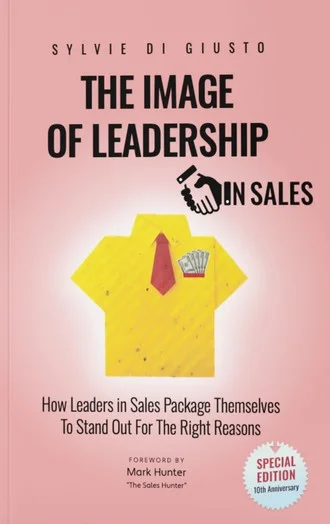
The Image of Leadership in Sales cover
The Quota of Influence

The Image of Leadership in Sales

Buyers decide whether to trust you long before they decide whether to buy.
Special edition · foreword by Mark Hunter

Order on Amazon

Every pitch starts before you say hello.

The Image of Leadership in Sales is written for the people who carry a number and the people who lead them. Before a client buys your product, they buy into you, and this edition shows sales leaders how appearance, behavior, communication, digital presence and environment decide whether prospects, clients and their own teams trust them enough to say yes.

What this book does so well is help us see how our success in sales begins with us. We send off so many signals, many unbeknownst to us, but very visible to the customer.
Mark Hunter“The Sales Hunter”, foreword to this edition

Who this edition is for

  • A top-performing account executive competing for a Vice President of Sales role
  • A Sales Development Representative making the first calls of a career
  • A Chief Revenue Officer or Chief Sales Officer setting the standard for an entire sales organization
  • A sales manager who has to address a team member’s attire, grooming or social media posts
  • A B2B enterprise seller or key account manager negotiating major deals and renewals
  • A sales leader in luxury, automotive, retail or medical devices whose presence must match the value of what they sell

The five signals, for Sales

AAppearanceWhat people see first, and keep seeing.
BBehaviorHow you act in the room, and when no one is watching.
CCommunicationThe verbal and nonverbal messages you send.
DDigitalWho you are online before anyone meets you.
EEnvironmentThe spaces and people you surround yourself with.
The opening story

Michael, David and the Vice President of Sales Role

Two sales professionals, Michael and David, are competing for the role of Vice President of Sales at a prestigious Fortune 500 company. Their résumés are equally strong. Both are greeted in the lobby by Jennifer, the Chief Sales Officer, and both walk with her past the sales dashboards to her glass-walled office. Michael’s interview is polite, pointed and over in twenty minutes. He leaves sensing the opportunity slipped through his fingers without knowing why. David’s conversation runs for an hour, pulls in the Senior Sales Manager, and ends with an invitation to continue next week. The next day, Jennifer tells the executive team that one candidate lacked conviction and the other exudes leadership. Same qualifications, same process, same interviewer. So what did Jennifer see in the lobby, before either man said a word, that your prospects and clients may be seeing in you?

Chapter 1 tells you what happened next.

Inside the book

  1. Seven SecondsWhy clients evaluate you before your pitch, using the story of two equally qualified candidates for a VP of Sales role, and what a poor professional imprint costs in stalled negotiations, pipeline erosion and lost commissions.
  2. Your Professional ImprintHow the imprint you leave is built and sustained across every client touchpoint, from the wrong logo in a board presentation to arriving disheveled after a day on the road, introduced through the ABCDEs of professional identity.
  3. Leaders Look ConfidentThe confidence killers specific to sales, including constant rejection, imposter syndrome, rapid change and quota and pipeline pressure, and how your look of leadership can shield you against them.
  4. Leaders Look AuthenticThe seven perception personas, from the Traditionalist in financial services to the Caregiver in healthcare sales and the Glamorous in luxury, and where each one wins or struggles with buyers.
  5. Leaders Look ProfessionalWhat professional means for sales leaders today, from branded dealership and retail uniforms to the unwritten uniforms of finance, tech and luxury sales, and the self-imposed rules that quietly undermine sellers.
  6. Leaders Look RespectfulHow a respectful presence turns transactional selling into trusted advisory work, illustrated by the enterprise sales VP, the winery business development director and the medical device leader hospital administrators treat as a peer.
  7. Leaders Look ControlledHow to take deliberate control of your professional identity, with preparation questions for prospecting calls, demos, negotiations and closing meetings, and how behavior, communication and environment carry through every phase of the sales cycle.
  8. Leadership in a Digital LandscapeYour LinkedIn profile, webcam setup and introductory emails as the new handshake, why prospects look you up during the meeting, and a five-step approach to managing the e-shadow that precedes you.
  9. Leaders Lead by ExampleWhy your team copies what you do, not what you say, the excuses sellers give for lowered standards, and how to hold difficult conversations about attire, hygiene or social media posts with confidence and fairness.
  10. Moving ForwardThe meaning of the potato chip on the cover, and what packaging, expectation and shelf placement teach sales leaders about staying visible, trusted and chosen by managers, clients and stakeholders.

Only in this edition

Invisible Filters Across the Table

Sylvie’s husband notices every bottle she leaves open and never the ones she closes. Prospects and team members work the same way. Outdated sales materials or worn product samples can trigger confirmation bias about your product’s quality. An early misstep becomes an anchor the client cannot let go of. A single hesitation on a technical question can set off the horn effect and color your entire pitch. This edition shows sales leaders how these filters operate, and how a consistent, authentic presence gradually reshapes them.

The Sustained Imprint Beyond the Close

In a leadership seminar run with horses, the group that walked in with confidence was followed everywhere, while the group offering treats and affection was ignored. Yet once the confident group turned inconsistent, the horse stopped following. For sales leaders, the lesson is direct: predictability and consistency earn trust and respect, and trying to be liked earns far less. A strong opening only gets you in the door. The real test is whether you confirm your value and substance in every interaction and decision that follows.

Don’t Be the Line That Disappears

Excellence is the new norm, and in sales “good” is merely the baseline. Average blends in, and by blending in, you become invisible. Sylvie uses Tetris to make the point: the piece that fits perfectly completes a line, and the line vanishes. Sales leaders who stand out become the piece that starts a reaction, the architect of their own perception. The book draws the line between the pop star’s attention at any cost and the professional distinction that builds trust, and names the three things that create it.

One Message, Boardroom to Social Feed

Your appearance, behavior, communication, digital footprint and environment must sing the same tune for your sales team, cross-functional partners and top management, as well as for prospects, clients and industry audiences. Professional by day and reckless after hours, or polished in person and careless in writing, sends mixed messages. The tougher test is your team: the member who behaves unprofessionally in the audience while you present at a major industry conference, or the picture-perfect seller whose social media tells another story. Each crack undermines your credibility as a leader.

Selling Yourself Without the Stigma

Sales leaders advocate for clients and solutions every day, yet many hesitate to advocate for themselves. Sylvie separates self-promotion from self-aggrandizement, addresses the fear of being seen as not team-oriented, and names the imposter syndrome many high achievers carry despite their results. As the CEO of your own career, you learn to claim achievements in a way that celebrates the team’s effort. She also challenges the relentless pursuit of perfection, where “good enough” rarely is, and replaces it with progress over perfection.

The Conversation You Keep Postponing

Sooner or later, every sales leader must address something uncomfortable with a team member: unfortunate social media posts, mismanaged emotions, neglected workspaces, disrespect toward stakeholders. Many delay it to protect team cohesion, or because the right words won’t come. Sylvie lays out a clear approach: prepare with precision, seek guidance from human resources or a legal advisor when needed, choose a private moment away from peak hours and stressful meetings, and open with specific praise. The goal is your team member’s professional growth, never personal criticism.

Questions readers ask

How can sales leaders build executive presence?

Executive presence is not built on clothing alone. The book defines your professional identity as the sum of your choices in five areas: appearance, behavior, communication, digital footprint and environment. An impeccable look can open doors, but behavior and communication sustain those connections, and your digital presence often decides whether you ever meet a prospect in person. Presence grows when all five tell the same story. Chapter 2, Your Professional Imprint, covers this in depth.

Why do qualified candidates lose out on sales leadership roles?

Because decision makers weigh more than the résumé. The book follows two candidates for Vice President of Sales with identical credentials; only one is seen as someone who could lead the team. Composure, readiness and a presence that fit the company's culture made the difference. A weak professional imprint can cost you credibility, the respect of your team and a stalled career trajectory. Chapter 1, Seven Seconds, covers this in depth.

What should sales professionals wear to meet a client?

There is no single dress code that works for every client. Every industry runs on silent standards, an unwritten uniform that prospects read at a glance. The book's advice is to read the room: observe the colors, fits and formality of the client's world, then decide how far to add your personal touch. The aim is to signal that you belong without hiding who you are. Chapter 5, Leaders Look Professional, covers this in depth.

How should sales leaders behave in a tough negotiation?

With composure. In sales, crises are a matter of when, not if, and your behavior carries as much weight as your appearance. In a critical negotiation, steady conduct, clear directives and swift decisions reflect the control your presence suggests, while fairness and integrity encourage clients to see value beyond the immediate transaction. Prospects and clients invest in relationships, not just products or services. Chapter 7, Leaders Look Controlled, covers this in depth.

How do I have a difficult conversation with a sales rep?

Prepare thoroughly: define the issue precisely, weigh its consequences for the team, clients and organization, and seek guidance from human resources when the topic is sensitive. Choose a private space and an unhurried moment. Open with specific praise, use neutral language based on what you observed yourself, and be explicit about the change you expect. Anticipate pushback, summarize, and follow up as promised. Chapter 9, Leaders Lead by Example, covers this in depth.

How important is LinkedIn for sales leaders?

Very. Your LinkedIn profile, company bio, webcam presence and introductory emails form today's digital handshake, often long before any face-to-face meeting, and prospects may even look you up during the meeting itself. Search engines act as the new background check. The book's point is consistency: the leader clients find online must be the same one they meet in the boardroom. Chapter 8, Leadership in a Digital Landscape, covers this in depth.

Does my office or my car affect how clients see me?

It can. The book notes that the car you drive, the books on your office shelves and the people you associate with all color how prospects and clients perceive you. An organized, functional workspace signals attention to detail during client visits, and a comfortable ambience can make closing meetings smoother. An unkempt car and a flashy sports car can both raise doubts about your judgment. Chapter 7, Leaders Look Controlled, covers this in depth.

Can I order copies for my team or conference?

Yes. Preferred pricing is available for groups, conferences and client gifts, and signed copies are available on request. Many organizations pair the book with The Power of Choice keynote, which is built on it.

Is this edition available as an ebook?

Yes. The Image of Leadership in Sales is available in paperback and as a Kindle ebook on Amazon.

Around the clock

Still have questions? Ask Edna.

Edna

Ready to make your people impossible to replace?