10 future of work keynote speakers worth booking
A note on selection and order: I have personally seen every speaker here present. That is my bar for including anyone. They are listed alphabetically by last name, not ranked, because this is a curated selection rather than a leaderboard. And yes, I have included myself.

Daniel Burrus
The anticipator. Best for: Leaders who need to separate what will certainly change about work from what merely might
One of the world’s best-known futurists, Daniel teaches the difference between hard trends, the future facts you can count on, and soft trends you can still influence. Applied to work, that distinction is gold: it tells leaders which shifts in skills, roles and technology to prepare for now, and which are noise. His approach turns anxiety about the future into an anticipatory plan.

Dan Chuparkoff
The translator. Best for: Teams that need AI and the future of work explained in their own industry’s language
Dan spent decades building technology at Google, Atlassian and McKinsey, and his keynote AI and the Future of Work does exactly what the title promises. He shows what AI does well, where it falls short and how people combine it with their own expertise to do better work, often customized to the audience’s industry. People leave less intimidated and ready to try.

Sylvie di Giusto
The human edge. Best for: Organizations asking what makes their people hard to replace
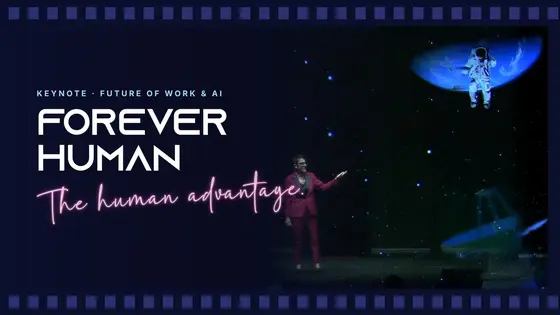
Full disclosure: that is me. My keynote Forever Human answers the question every workforce is quietly asking: will a machine do my job? I focus on what makes people and organizations irreplaceable as automation spreads, and on the human skills that grow more valuable, not less. I deliver it as an immersive 3D experience or as a traditional keynote.

Jason Dorsey
The generational researcher. Best for: Leaders managing, hiring or selling to Gen Z and Millennials
Jason runs a generational research firm, and his keynotes run on data, not stereotypes. He shows how Gen Z and Millennials actually work, decide and stay, and where long-held assumptions are quietly costing organizations talent. With five generations in today’s workforce, his lens is one of the most practical ways into the future of work, because much of it has already arrived.

Heather McGowan
The adaptability strategist. Best for: Organizations that need their people to learn and adapt faster than the work changes
Heather is one of the most recognized voices on the future of work, named among Forbes’ top futurists and co-author of The Adaptation Advantage and The Empathy Advantage. Her argument: as technology reshapes the work, our identity can no longer be tied to a job title. She helps leaders build curious, adaptable people who can solve tomorrow’s problems, not just today’s.

Kate O’Neill
The tech humanist. Best for: Leaders deciding how much technology should shape the way their people work
Known as the Tech Humanist, Kate helps organizations make technology decisions that are good for business and good for people. Her lens on the future of work is refreshingly grounded: start with what matters to humans, then decide what to automate. A Thinkers50-recognized management thinker and one of the first 100 employees at Netflix, she brings strategy and humanity in equal measure.

Smiley Poswolsky
The belonging builder. Best for: Hybrid and distributed teams that feel disconnected
Smiley is a workplace belonging expert and the author of Friendship in the Age of Loneliness. As work becomes more remote, hybrid and AI-assisted, he makes the case that human connection is a performance strategy, and shows leaders how to build belonging, psychological safety and engagement across generations. Warm, funny and practical, he gets even skeptical rooms talking to each other.

John Sanei
The futurist. Best for: Executives rethinking roles, purpose and business models
A Singularity University faculty member, John helps leaders see how technology is lowering the cost of entire categories of work, and what that means for the business models and careers built on them. His take on the future of work centers on purpose as a skill and on the human capacities worth building alongside AI: creativity, empathy and intuition.

James Taylor
The creative. Best for: Teams that want to stay creative and original as AI enters their work
James reframes AI as a multiplier of human creativity rather than its replacement. His SuperCreativity work, and the book of the same name, shows teams how humans and AI collaborate to generate bigger ideas without flattening their originality. For any workforce worried that AI will make its craft obsolete, James turns the threat into a collaborator.

Mike Walsh
The organization architect. Best for: Executives redesigning how their company runs with AI
Mike studies how AI rewires organizations at the deepest level: not the tools, but the operating models, roles and leadership that intelligent machines rewrite. His book The Algorithmic Leader helps executives design for a world where humans and algorithms work side by side, instead of bolting yesterday’s org chart onto tomorrow’s technology.