
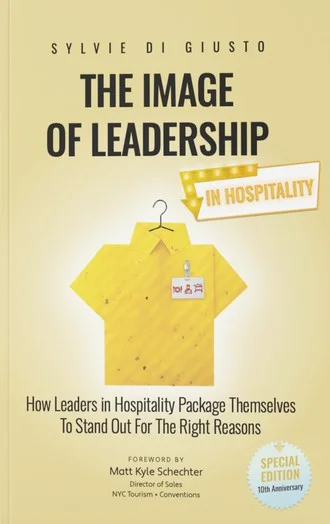
The Image of Leadership in Hospitality cover
The Recipe of Influence

The Image of Leadership in Hospitality

In hospitality, the guest experience starts with how you show up.
Special edition · foreword by Matt Kyle Schechter

Order on Amazon

Guests have read you before the first welcome.

In hospitality, guests and staff decide whether to trust you before you have said a word about occupancy rates or guest satisfaction scores. The Image of Leadership in Hospitality shows hotel, restaurant, event and travel leaders how to shape a professional identity that earns that trust in the lobby, the kitchen, the boardroom and online. It also equips you to raise the standard for the uniformed, guest-facing teams who represent your brand every shift.

Sylvie equips leaders with the tools to uphold a consistent image while adapting to different situations and cultures, a skill that’s never been more important as our industry continues to globalize.
Matt Kyle SchechterDirector of Sales, NYC Tourism + Conventions, foreword to this edition

Who this edition is for

  • A newly promoted food and beverage manager stepping into authority over a former peer group
  • A seasoned hotel general manager who wants a look of leadership that still reflects who they are today
  • A mid-level professional preparing for a strategic leap into senior restaurant management
  • A leader aiming for a top executive position at a luxury resort or global hospitality brand
  • An event planner or coordinator whose presence has to move from outdoor gatherings to black-tie galas
  • A boutique travel agency founder or hospitality trainer who leads without a prescribed uniform

The five signals, for Hospitality

AAppearanceWhat people see first, and keep seeing.
BBehaviorHow you act in the room, and when no one is watching.
CCommunicationThe verbal and nonverbal messages you send.
DDigitalWho you are online before anyone meets you.
EEnvironmentThe spaces and people you surround yourself with.
The opening story

Two Candidates, One Résumé

Martin and Jonathan are competing for the same career-defining role: Director of Guest Experience at a luxury resort within a prestigious hotel chain. On paper, they are identical. Their résumés match line for line. Both are greeted in the resort’s administrative lobby by Jennifer, the Chief Hospitality Officer, with the same confident smile and firm handshake. Yet the two interviews could not unfold more differently. Martin walks past the real-time occupancy dashboards in uneasy silence, answers pointed questions, and leaves after twenty minutes sensing he has been ushered out. Jonathan’s conversation turns into an hour of genuine exchange, including an impromptu meeting with the senior manager of sustainability. The next day, at the executive leadership meeting, Jennifer delivers her verdict on each man in a single sentence. Same qualifications, same resort, same interviewer. So when was the decision really made, and what did Jennifer see that neither résumé could show?

Chapter 1 tells you what happened next.

Inside the book

  1. Seven SecondsHow staff and guests read you in the lobby, at check-in or in your first staff meeting, why that window is too short to prove your expertise, and how the details of your presence decide whether the door opens.
  2. Your Professional IdentityWhy Sylvie chooses professional identity over executive presence or personal branding, and how the ABCDEs (appearance, behavior, communication, digital footprint, environment) must stay consistent for a hospitality leader moving from shadows to spotlight.
  3. Leaders Look ConfidentConfidence as the foundation a hospitality leader’s presence is built on, including confidence about your body, your age, your gender identity and your style in an industry that serves guests from every walk of life.
  4. Leaders Look AuthenticThe perceived uniforms of hospitality, from chefs and concierges to spa therapists and tour guides, and seven keyword styles that show where personas such as the Cosmopolitan or the Glamorous thrive across hotels, restaurants and events.
  5. Leaders Look ProfessionalUniforms as silent ambassadors, the unwritten uniforms of luxury hotels, boutique properties and event planning, the internal mandates leaders impose on themselves, and when to dress for a kitchen walkthrough or a crisis instead of the boardroom.
  6. Leaders Look RespectfulHow your presence signals respect for yourself, your staff, your guests and a global clientele, why respect is not always returned, and how to recover when a misstep at the front desk spreads online.
  7. Leaders Look ControlledSelf-awareness, self-care and self-promotion for leaders who give everything to guests and staff, plus the daily questions to ask before a board meeting, a staff training, a VIP event or a drive to another property.
  8. Leadership in a Digital LandscapeManaging your e-shadow when guests name you on review platforms, deciding whether to accept friend requests from staff and guests, and keeping your digital presence consistent with the leader they meet in the hotel or restaurant.
  9. Leaders Lead by ExampleWhy leading by example creates an organic dress code stronger than any policy, the excuses staff give (including the idea that professionalism has a zip code), and how to hold sensitive conversations about appearance and conduct.
  10. Moving ForwardA closing reflection on committing to your professional identity for the long run, told through the potato chip on the cover and what it reveals about how staff and guests come to trust a hospitality leader.

Only in this edition

The invisible filters your guests and executives apply

Science knows roughly 185 unconscious biases, and every guest, staff member and executive brings them through your door. Confirmation bias collects evidence for what people already believe. Anchoring bias lets one early detail color everything after it. The horn effect turns a single perceived flaw, a hesitant answer about occupancy trends or a cluttered office before a guest-satisfaction meeting, into a verdict on your whole performance. Sylvie shows how these silent storytellers work against hospitality leaders, and how the same biases can be made to work in your favor.

Respected, not liked: the sustained imprint

At a leadership seminar in Europe, the trainers were horses. One group won the horse over with confidence; the other brought kindness, petting and treats, and the horse stopped following once the treats ran out. Yet the winning group lost its hold the moment its conduct became unpredictable. Sylvie draws two lessons for hospitality leaders: respect is the foundation and being liked is a bonus, and predictability and consistency are what engender trust. The book explains how outstanding leaders turn a strong start into an imprint that lasts.

Good is the baseline in hospitality

In hotels, restaurants and travel services, excellence is the new norm and “good” is simply what guests expect. Sylvie uses the game of Tetris to make the point: the piece that fits perfectly completes a line and disappears. A triumph in the game, a warning in your hospitality career. The leaders who rise become the piece that fits and also starts a reaction, challenging the status quo and creating a new path for guest experience and operational excellence. The book separates standing out for the right reasons from standing out for its own sake.

One message, from back office to tourism board

Your appearance, behavior, communication, digital footprint and environment must all sing the same tune, inside your property and in front of investors, tourism boards, industry conferences and guests. Sylvie shows how quickly that message cracks: a polished conference presentation undermined by a staff member’s conduct in the audience, or an impeccable team member whose social media tells another story. Consistency is not only your own discipline. The book shows why the true test of a hospitality leader is making it permeate the entire staff, anytime, anywhere and with anyone.

Advocating for your own work

If you don’t advocate for your achievements, who will? Many hospitality leaders hold back for fear of sounding boastful, of seeming less team-oriented, or because imposter syndrome whispers that they will be exposed. Sylvie reframes self-promotion as controlling your narrative: articulating the value you bring to your organization, not out of vanity, and raising the profile of your staff’s efforts along the way. As the CEO of your own career, she argues, you also need to trade the exhausting pursuit of perfection for progress over perfection.

The conversations leaders avoid

Sooner or later a hospitality leader has to talk with a staff member about something uncomfortable: personal hygiene, emotions mismanaged with guests, an unfortunate social media post, disrespect toward a guest. Many postpone it to protect harmony on the team. Sylvie offers a clear path: prepare with precision, seek guidance from HR or legal where needed, and never hold the talk in a lobby or dining room or during peak operational hours. Open with specific praise, use neutral language, and keep the focus on the staff member’s growth, not on blame.

Questions readers ask

Why do hardworking hospitality managers get passed over for promotion?

Being known for good work is not enough. The book describes four visibility levels: invisible, common, unique and referrable. Reliable managers often stall at being common: recognized for running the front desk or kitchen well, but seen as dependable and interchangeable. Promotions go to leaders whose strengths are advocated by others, often without their direct involvement. Getting there takes intentional work on your whole professional identity. Chapter 2, Your Professional Identity, covers this in depth.

How can a hospitality leader promote their achievements without seeming arrogant?

Reframe self-promotion as advocacy, not bragging. If you do not articulate the value you bring, who will? The book positions you as the CEO of your own career, controlling your narrative so your contributions are known, seen and heard. Done well, it also raises the profile of your staff's efforts. The book also addresses why imposter syndrome and cultural norms hold many leaders back. Chapter 7, Leaders Look Controlled, covers this in depth.

Should a hotel or restaurant leader dress differently for a crisis or a visit to the kitchen?

Situational awareness sometimes outranks the usual rules. During a major renovation, a food-safety incident or an industry-wide crisis, a practical, less formal look signals that you are engaged and standing with your staff. When you step into a production kitchen or housekeeping area, adapting your look shows you understand the conditions your team works in. And you represent your organization around the clock. Chapter 5, Leaders Look Professional, covers this in depth.

How should a hospitality leader recover after a mistake with a guest or staff member?

Avoid two common pitfalls. Ignoring the problem hands control of your reputation to others, because your professional identity is also what people say behind your back. A quick, hollow apology can deepen distrust. With guests, a misstep can reach review platforms or social media within hours; with staff, it quietly erodes morale and trust. The book shows how to respond at every scale. Chapter 6, Leaders Look Respectful, covers this in depth.

How do I talk to an employee about a sensitive issue like hygiene, attire or a social media post?

Keep the focus on supporting their professional development, not criticizing them personally. Prepare by defining the issue precisely and its impact on guests, colleagues and the organization; if it affects no one, there is no need for the conversation. Consult HR or a legal advisor on sensitive topics. Choose a private space, never a lobby or dining room, and avoid peak operational hours. Chapter 9, Leaders Lead by Example, walks through the full conversation.

What do people find when they search a hospitality leader's name online?

Search engines now act as the new background check, and staff may look you up during a meeting break. Start by knowing what is out there: search your name, common typos and titles across major search engines, and check industry review sites such as Tripadvisor, Yelp and OpenTable. Outdated profiles or a poorly chosen photo send signals too. Chapter 8, Leadership in a Digital Landscape, covers this in depth.

Do a hotel manager's office, car and personal associations affect how staff see them?

The book treats environment as part of your professional identity. An older, poorly maintained car or a luxury sports car can each prompt assumptions among your staff. An organized, functional office signals professionalism and attention to detail. The friends, family and colleagues you associate with reflect on you too, so surround yourself with people who support and amplify your professional identity. Chapter 7, Leaders Look Controlled, covers this in depth.

Can I order copies for my team or conference?

Yes. Preferred pricing is available for groups, conferences and client gifts, and signed copies are available on request. Many organizations pair the book with The Power of Choice keynote, which is built on it.

Is this edition available as an ebook?

Yes. The Image of Leadership in Hospitality is available in paperback and as a Kindle ebook on Amazon.

Around the clock

Still have questions? Ask Edna.

Edna

Ready to make your people impossible to replace?