
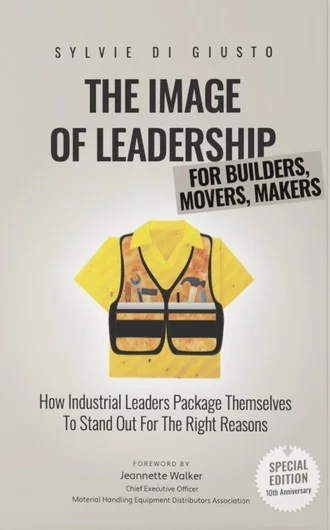
The Image of Leadership for Builders, Movers, Makers cover
The Pathway of Influence

The Image of Leadership for Builders, Movers, Makers

On the shop floor and in the boardroom, credibility is earned in what people see you do.
Special edition · foreword by Jeannette Walker

Order on Amazon

A hard hat doesn’t hide how you lead.

The Image of Leadership for Builders, Movers, Makers is written for leaders who move between the boardroom, the plant floor, the distribution center and the job site in a single day. It shows you how to close the gap between the rugged, hands-on image people hold of your industry and the gravitas expected of the decision-makers behind it, so that your professional identity carries the same precision and reliability as your operations.

Through her expertise, she has reinforced the notion that success isn’t just about what we do, it’s about how we are perceived.
Jeannette WalkerCEO, Material Handling Equipment Distributors Association, foreword to this edition

Who this edition is for

  • A newly promoted production supervisor stepping into a first leadership role
  • An emerging leader with sights set on a leadership position in logistics
  • A seasoned project manager preparing for a strategic leap into senior project management
  • A senior leader aiming for a top executive position in a manufacturing or logistics organization
  • A woman leading teams in construction, manufacturing or logistics, where female executives remain the exception
  • A leader whose teams work in uniforms and safety gear and who sets the standard for how that gear is worn

The five signals, for Industrial

AAppearanceWhat people see first, and keep seeing.
BBehaviorHow you act in the room, and when no one is watching.
CCommunicationThe verbal and nonverbal messages you send.
DDigitalWho you are online before anyone meets you.
EEnvironmentThe spaces and people you surround yourself with.
The opening story

Two Candidates, One Operations Role

Martin and Jonathan are competing for the same career-defining job: director of operations at a state-of-the-art production facility. On paper, they are identical. Their résumés match line for line, and both have earned an interview with Jennifer, the chief operations officer. Each waits in the same sleek lobby of the administrative area, and each walks with Jennifer past dashboards of real-time production metrics to her office. Martin’s interview lasts twenty minutes. The conversation stays polite and pointed, he senses the opportunity slipping away like water through his fingers, and he leaves feeling hastily ushered out. Jonathan’s lasts an hour. It pulls in the senior manager of sustainability and ends with an invitation to continue next week. The next day, in the executive leadership meeting, Jennifer’s verdict on the two candidates is swift and decisive. Same qualifications, same building, same interviewer. So what did Jennifer see in those first seconds that the résumés never showed?

Chapter 1 tells you what happened next.

Inside the book

  1. Seven SecondsHow team members, clients and senior management size you up before you speak, whether you walk into a project review with engineers, cross a warehouse toward a client facing a supply chain disruption, or log into a virtual meeting.
  2. Your Professional IdentityWhy professional identity, not executive presence, is the right frame for industrial leaders, and how appearance, behavior, communication, digital footprint and environment must align from the construction site to the trade show floor and beyond.
  3. Leaders Look ConfidentConfidence in an industry reshaped by smart factories and constant change: the pressure to compare production metrics, the physical expectations of the shop floor, age, and the gender dynamics of fields long seen as men’s work.
  4. Leaders Look AuthenticWhy authenticity is no excuse to ignore the norms and safety standards of your field, how a junior engineer’s look evolves into a leader’s, and a brief introduction to seven keyword styles that anchor your professional identity.
  5. Leaders Look ProfessionalDressing for a role that runs from boardroom negotiation to site inspection: uniforms and PPE as silent ambassadors, ten team attitudes toward them, the unwritten uniforms of your field and the self-imposed rules that hold leaders back.
  6. Leaders Look RespectfulHow self-respect shows in the polished yet practical look of a VP of manufacturing or a logistics director, why respect is not always reciprocated, and how to recover when a misstep on site or at a trade show goes public.
  7. Leaders Look ControlledTaking command of your narrative through self-awareness, self-care and self-promotion, plus the questions to ask each morning when the day may lead from a safety meeting to a supplier negotiation to a factory floor.
  8. Leadership in a Digital LandscapeManaging the digital handshake that precedes every meeting, from your profile picture and posts on construction safety forums to supplier ratings, subcontractor evaluations, industry directories and the risk of a recorded misstep.
  9. Leaders Lead by ExampleHow your choices set the unspoken standard for your team, the excuses you will hear (including that professionalism has a zip code), and how to hold a difficult conversation about attire or conduct without disrupting operations.
  10. Moving ForwardThe closing lesson behind the potato chip on the cover: why your packaging matters in construction, logistics and manufacturing, and how to stay at eye level for the people who decide who leads next.

Only in this edition

The Invisible Filters on the Plant Floor

A top executive walks into your office for a meeting about operational efficiency. A slight hesitation on a question about production trends or an inconsistent follow-up on project updates can trigger the horn effect. Anchoring bias then holds on to that moment, and selection bias hunts for every further flaw. When a client touring your facility is greeted by a distracted team member, confirmation bias turns each untidy workstation into proof. Sylvie unpacks the unconscious biases that shape how industrial leaders are judged, and how to make them work in your favor.

The Sustained Imprint

Like machinery left without maintenance or equipment left uncalibrated, even the strongest leadership presence loses its effectiveness over time. In a seminar Sylvie organized in Europe, the trainers were horses. One group earned instant compliance through confident, decisive conduct; the other offered treats and affection and got little in return. Yet the first group’s success faded the moment their behavior became unpredictable. The lesson for industrial leaders: being liked is a bonus, being respected is the foundation, and predictability and consistency build lasting trust, shift after shift.

More Than a Completed Line

In Tetris, the piece that fits perfectly completes a line and disappears. That is a triumph in the game and a warning in your career. In the bustling world of manufacturing, logistics and construction, “good” is the baseline, the expectation, and average blends in until it becomes invisible. Sylvie explains why standing out for its own sake is a terrible idea, and what it takes to stand out for the right reasons: to be the piece that starts a reaction and creates a new path toward operational excellence and innovation.

One Message, From Trade Show to Site

Your appearance, behavior, communication, digital footprint and environment must all sing the same tune. Surround yourself with cutting-edge technology while claiming a reputation for traditional craftsmanship, and the message cracks. Consistency matters internally, with your team, cross-functional projects and senior management, and externally, with investors, clients, trade shows and your community. It extends to every team member, from the one who speaks loudly during your conference presentation to the one whose social media contradicts their professional conduct. Sylvie shows how to build one credible front.

Let the Results Be Known

If you don’t advocate for your achievements, who will? Highlighting how you optimized a critical process on the production line or kept your team efficient through a major supply chain disruption is not self-centeredness; it shows the tangible results of your leadership. Sylvie separates effective self-promotion from bragging, confronts the fear of backlash and the imposter syndrome that haunts high achievers, and asks you to act as the CEO of your own career. She also challenges the relentless pursuit of perfection and makes the case for progress over perfection.

The Conversations Leaders Avoid

Safety violations, personal hygiene, emotions that flare in workplace interactions, problematic social media posts: some conversations cannot wait, and none should be rushed. Sylvie explains why leaders avoid them and how to hold them with confidence. Prepare with precision or, when safety demands immediate escalation, ground yourself in the facts and stay calm. Consult HR or a legal advisor, never talk on the factory floor or in a shared break room, avoid critical production hours, open with specific praise and keep the focus on resolution rather than blame.

Questions readers ask

Why do qualified candidates lose out on operations leadership roles?

Because a strong résumé only earns you the interview. The book follows Martin and Jonathan, two candidates with identical résumés competing for a director of operations role. One was asked back; the other was shown the door, and the executive who decided would never cite the real reason. Martin never got the chance to prove the depth of his expertise. Chapter 1, Seven Seconds, shows what quietly decided the outcome.

How do I move from managing a plant or project site into senior leadership?

Doing good work is rarely enough. Sylvie describes four visibility levels: invisible, common, unique and referable. Many hardworking leaders stall at common, known for running a production line or project site well, yet interchangeable, and wonder why they are not getting ahead. Promotions go to leaders who are referable, recommended in high-level meetings without their involvement. Chapter 2, Your Professional Identity, explains how to get there.

Is there an unwritten dress code for leaders in manufacturing, logistics and construction?

Yes. Even without formal mandates, silent standards shape how you are read: a logistics manager may skip the hard hat yet adopt a polished, practical look, while a senior engineer on site wears functional attire that signals competence. Decode yours by observing the leaders around you, the context of each interaction and the expectations of your role, then add your personal touch. Chapter 5, Leaders Look Professional, explores these unwritten uniforms.

How should a leader rebuild trust after a mistake on site or with a client?

Avoid the two common pitfalls: ignoring the problem and offering a hollow apology. With clients, external issues often require a prompt and composed response that projects confidence, control and accountability. With your team, apologize privately and in person whenever possible, own the mistake without excuses such as "It's just a casual Friday," share what you have learned and listen more than you speak. Chapter 6, Leaders Look Respectful, covers damage control in depth.

How should leaders in industrial fields communicate with their crews?

Directness alone is not enough. Where instructions, safety protocols and project updates dominate conversations, it is easy to overlook the emotions and intentions behind what is being said. Active listening, body language, tone and clear written reports all shape your authority. When introducing new safety protocols, explain rather than just direct, and choose words that inspire, not just inform. Chapter 2, Your Professional Identity, and Chapter 7, Leaders Look Controlled, cover this.

Does a construction or manufacturing leader really need a strong LinkedIn presence?

Yes. Search engines act as the new background check, and clients and partners examine the digital personas of the leaders they choose to work with. An outdated certification on your profile or posts disconnected from current industry concerns send the wrong message. Supplier ratings, subcontractor evaluations and industry forums deserve attention. Sylvie's five steps (know, repair, own, control, monitor) put you in charge. Chapter 8, Leadership in a Digital Landscape, covers this in depth.

What does a leader's truck, site office or video-call background say about them?

More than most leaders assume. An older, poorly maintained truck can suggest a disregard for operational efficiency, while a high-end luxury car may raise questions about your priorities. Whether you lead from a control room, an on-site project office or a boardroom, an organized, functional space signals precision. On camera, a cluttered background undermines your authority. Chapter 7, Leaders Look Controlled, and Chapter 8, Leadership in a Digital Landscape, cover your environment.

Can I order copies for my team or conference?

Yes. Preferred pricing is available for groups, conferences and client gifts, and signed copies are available on request. Many organizations pair the book with The Power of Choice keynote, which is built on it.

Is this edition available as an ebook?

Yes. The Image of Leadership for Builders, Movers, Makers is available in paperback and as a Kindle ebook on Amazon.

Around the clock

Still have questions? Ask Edna.

Edna

Ready to make your people impossible to replace?