
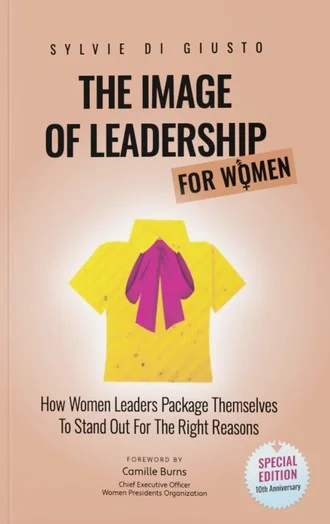
The Image of Leadership for Women cover
The Kaleidoscope of Influence

The Image of Leadership for Women

Women leaders are read on more signals, more often. Choose the ones you send.
Special edition · foreword by Camille Burns

Order on Amazon

You are being read. Decide what they see.

The Image of Leadership for Women helps you build a professional identity that keeps the spotlight on your expertise, not your appearance, in rooms where women are still judged by their covers. It shows you how to be seen as a leader without dressing like a man, overplaying femininity or neglecting yourself, so that people trust you, follow you and choose you.

Let this book be both a mirror and a map, reflecting the current landscape of women’s leadership and charting a course for future achievements.
Camille BurnsCEO, Women Presidents Organization, foreword to this edition

Who this edition is for

  • A mid-level professional eyeing a strategic leap into senior management
  • A seasoned executive aiming for the C-suite
  • The only woman at the table in a male-dominated industry
  • A woman leading in a uniformed field such as law enforcement, the military, aviation or manufacturing
  • A leader in government, education or the nonprofit sector
  • An entrepreneur building a company and a personal brand at the same time

The five signals, for Women

AAppearanceWhat people see first, and keep seeing.
BBehaviorHow you act in the room, and when no one is watching.
CCommunicationThe verbal and nonverbal messages you send.
DDigitalWho you are online before anyone meets you.
EEnvironmentThe spaces and people you surround yourself with.
The opening story

Susan, Kendra and the Marketing Director Role

Susan and Kendra are competing for the same prize: marketing director at a prestigious Fortune 500 company, a major step in both careers. On paper they are equal. In fact, their résumés are identical. Both are greeted in the sleek lobby by Peter, the chief of marketing, with the same confident smile and firm handshake. Susan’s interview ends after twenty minutes of pointed questions and an uncomfortable silence, and she walks out sensing she has been hastily ushered to the door. Kendra’s conversation runs an hour, pulls in the senior marketing manager and ends with an invitation to continue next week. The next day, Peter tells his leadership team that one candidate lacked conviction and the other exudes leadership. Same qualifications, same interviewer, same building. So what did Peter see in those first seconds in the lobby, long before either woman said a word about her experience?

Chapter 1 tells you what happened next.

Inside the book

  1. Seven SecondsTwo women with identical résumés compete for a Fortune 500 marketing role. The chapter shows why women are still judged by their covers, from power suits to shoes, and what a weak professional imprint costs in credibility, promotions and income.
  2. Your Professional ImprintHow your imprint forms in seconds and must be sustained over years, including the invisible filters, such as sex role identification, that people apply to women leaders, and an introduction to the ABCDEs of your professional identity.
  3. Leaders Look ConfidentConfidence about your body, your age, your gender and your style, set against research on how women underrate their own performance, the Howard vs. Heidi likeability bias and the double bind of being expected to be nurturing yet decisive.
  4. Leaders Look AuthenticWhy “you do you” is misleading advice, and how seven keyword styles, from the Explorer to the Dramatic, help you define an authentic look of leadership across the many roles a woman plays at work and at home.
  5. Leaders Look ProfessionalFrom the old dress code levels to the uniforms women wear in law enforcement, the military, aviation and manufacturing, the unwritten uniforms of finance, tech, education and nonprofits, and the internal mandates women quietly impose on themselves.
  6. Leaders Look RespectfulHow the executive, the entrepreneur and the educator signal self-respect through fit, quality and care, why investing in yourself is not vanity, and how culturally aware choices show respect for the people you lead.
  7. Leaders Look ControlledSelf-awareness, self-care and self-promotion for women who tend to put everyone else first, plus questions to ask yourself before dressing for spaces where women are underrepresented, and why behavior and communication must match the look.
  8. Leadership in a Digital LandscapeYour digital handshake now precedes the real one. This chapter covers profile pictures, virtual meeting setups, search results and the stereotypes women face online, and introduces five steps to take command of your e-shadow.
  9. Leaders Lead by ExampleYour choices become your team’s organic dress code. The chapter takes on the excuses leaders hear, from the weather to “we’re in the suburbs, not Manhattan,” and prepares you for the uncomfortable conversation about attire, hygiene or social media.
  10. Moving ForwardThe potato chip on the cover, explained. What chip packaging teaches about consistency, expectation and trust, and why a convincing professional identity earns you patience for the human flaws every leader has.

Only in this edition

The Invisible Filters Women Are Judged Through

Confirmation bias, anchoring bias and the horn effect rarely announce themselves, yet they shape how a woman leader’s competence is read long before she speaks. Sylvie walks you through one ordinary visit in which a delayed greeting and a crumpled paper quietly convict an entire organization, then shows how the same mental shortcuts can work in your favor. For women, who are often held to a stricter social ledger, understanding these filters is not optional. It is how you stop being judged by the shortcut and start being judged by your work.

The Sustained Imprint

Getting in the door is only the beginning. Through a leadership seminar in which the trainers were horses, Sylvie reveals why the group that offered treats and affection never earned the horse’s attention, and why the confident group lost it later, once their conduct became unpredictable. Predictability and consistency, not warmth alone, are what earn trust and respect. For women leaders navigating the delicate balance between competence and likeability, the lesson is freeing: the goal is not to be liked by everyone, but to be reliably respected, every day and in every room.

Why “Good” Makes You Disappear

Excellence is the new norm, and “good” is merely the baseline. Sylvie borrows a lesson from Tetris: the piece that fits perfectly completes a line, and then it vanishes. For women who have been encouraged to fit in, align and avoid standing apart, that is a sobering warning. The book separates standing out for its own sake from standing out for the right reasons, built on three deliberate choices, and shows how women leaders become the piece that starts a reaction rather than the line that quietly disappears.

One Message, Inside and Outside

Your appearance, behavior, communication, digital footprint and environment must all sing the same tune. A trustworthy presence undone by unpredictable behavior, or an online persona that contradicts the leader colleagues know, sends mixed messages that erode credibility. Sylvie separates your internal identity, with your team, peers and top management, from your external identity at conferences, community events and on social media. She then explains why the standard extends to every team member who represents you, whether in corporate, government, education, nonprofit or entrepreneurial settings.

Claiming Your Achievements Without Apology

Many women were encouraged to be collaborative and communal rather than self-promoting, so highlighting an accomplishment can feel like bragging. Add imposter syndrome, cultural norms that equate self-praise with boasting and the fear of backlash, and silence starts to look safe. Sylvie reframes self-promotion as advocacy for the value you bring and invites you to act as the CEO of your own career. She also confronts the relentless pursuit of perfection, making the case for progress over perfection and for celebrating small victories along the way.

The Conversations Leaders Avoid

Sooner or later every leader must address something uncomfortable with a team member: an unfortunate social media post, mismanaged emotions, a neglected workspace, a lack of respect toward stakeholders. Many hesitate, wanting to preserve harmony, avoid emotional distress or stay nonconfrontational. Sylvie offers a clear sequence for these moments: prepare with precision, seek guidance when legal issues are involved, choose a private space and a calm moment, and open with specific praise. The aim is never criticism. It is your team member’s professional growth.

Questions readers ask

Why do qualified women get passed over for leadership roles?

Credentials earn the invitation; they rarely decide the outcome. The book opens with two candidates holding identical résumés for the same marketing director role. One leaves with a follow-up meeting, the other is quietly ushered out. Sylvie shows how appearance, behavior, communication and online presence shape whether you are seen as a leader, and why this weighs more heavily on women. Chapter 1, Seven Seconds, covers this in depth.

How can women leaders promote their achievements without seeming self-important?

Many women were taught to be collaborative rather than self-promoting, and many fear backlash or feel like impostors when they claim credit. The book reframes self-promotion as a leadership skill: advocacy for the value you bring, shared in a way that also celebrates your team's effort. It pairs this with a call to trade perfectionism for progress, so growth fuels confidence rather than exhaustion. Chapter 7, Leaders Look Controlled, covers this in depth.

How should a woman leader dress to be taken seriously?

There is no single rule book anymore. Sylvie recommends a personal dress code that bolsters your confidence, reflects your industry and organization, considers the people you serve, and lets your presence take center stage rather than your clothes. It avoids both mirroring masculine dress and leaning overly feminine. And rather than dressing only for the next rung, dress with the pinnacle of your career in mind. Chapter 5, Leaders Look Professional, covers this in depth.

How do women leaders stay composed and credible under pressure?

In the book's view, behavior carries as much weight as appearance. A polished look becomes an empty shell when your conduct contradicts it. In a crisis or a critical negotiation, your composed demeanor, clear directives and swift decisions confirm the authority others expect. Sylvie asks leaders to be the steady presence in turmoil, the clarity in uncertainty and the empathy in every strategic decision. Chapter 7, Leaders Look Controlled, covers this in depth.

How do I have a difficult conversation with someone on my team?

Many leaders avoid these talks to protect harmony or because they can't find the words, whether the issue is attire, emotions, a social media post or how stakeholders are treated. The book treats each conversation as support for professional development, not personal criticism. It covers preparation, when to involve HR or legal advisors, neutral and specific language, handling pushback, follow-up and documentation. Chapter 9, Leaders Lead by Example, covers this in depth.

What should women leaders do about what shows up when someone searches their name?

The digital handshake (a LinkedIn profile, a company bio, a webcam glance) often precedes any meeting, and search engines act as the new background check. The book lays out five steps: know what is out there, repair what doesn't serve you, own your name across platforms, control your digital boundaries and monitor continuously. The aim: an online presence that affirms the leader people meet. Chapter 8, Leadership in a Digital Landscape, covers this in depth.

Do my car, my office and the people around me affect how I'm seen as a leader?

Yes, according to the book. From the car you drive to the books on your office shelves, your choices color how others see you. A neglected car may raise doubts about your organizational skills; a luxury sports car may prompt questions about your financial judgment. You are also judged by the company you keep, so surround yourself with people who support your professional identity. Chapter 7, Leaders Look Controlled, covers this in depth.

Can I order copies for my team or conference?

Yes. Preferred pricing is available for groups, conferences and client gifts, and signed copies are available on request. Many organizations pair the book with The Power of Choice keynote, which is built on it.

Is this edition available as an ebook?

Yes. The Image of Leadership for Women is available in paperback and as a Kindle ebook on Amazon.

Around the clock

Still have questions? Ask Edna.

Edna

Ready to make your people impossible to replace?