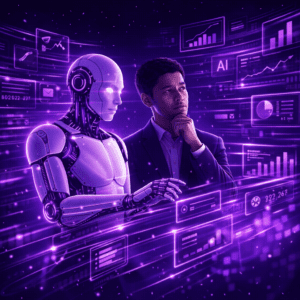
 One of the most visible strengths of artificial intelligence is speed. AI systems can analyze enormous datasets, generate alerts, and identify correlations within seconds. Financial anomalies, supply chain disruptions, customer behavior patterns, and operational inefficiencies can be detected almost instantly. For organizations that once waited weeks or months for analytical insights, this represents a dramatic transformation.
This is the first half of the relationship between Artificial Intelligence versus Human Intelligence. Artificial intelligence excels at computation. It processes signals, remembers enormous quantities of data, and applies statistical models with remarkable efficiency. Machines do not forget transactions, and they do not overlook small irregularities hidden within millions of data points.
However, speed introduces a subtle leadership challenge. When information arrives instantly, organizations begin expecting decisions to arrive just as quickly. Dashboards refresh constantly, alerts demand immediate responses, and executives feel pressure to react to signals rather than analyze them. Speed becomes addictive, yet speed is not the same as understanding.
Artificial intelligence can detect that something unusual happened. Human intelligence determines whether it actually matters. The organizations that navigate Artificial Intelligence versus Human Intelligence effectively understand this distinction. They use machines to accelerate insight while protecting the time required for human judgment. Without that balance, speed begins to overwhelm meaning.
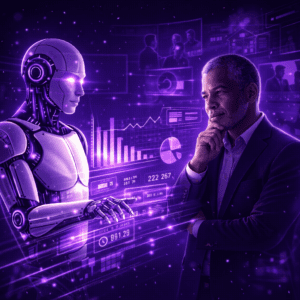 If artificial intelligence is excellent at detecting patterns, human intelligence excels at interpreting them. Data rarely tells a complete story on its own. An algorithm may identify declining employee engagement, unusual customer purchasing behavior, or unexpected production delays. Yet numbers alone rarely explain why these things occur.
This is where the second half of Artificial Intelligence versus Human Intelligence becomes powerful. Humans interpret context. Leaders remember conversations that never appeared in reports. They recall the tension during a meeting that signaled deeper organizational problems, and they recognize when a seemingly minor issue could become a major cultural risk.
Human intelligence connects facts with experience. A dataset may show that productivity dropped in a specific quarter, yet a leader may recall that the organization underwent restructuring, experienced leadership changes, or faced market uncertainty during that same period. Numbers identify patterns, but humans interpret causes. Without that interpretation, even the most sophisticated analytics remain incomplete.
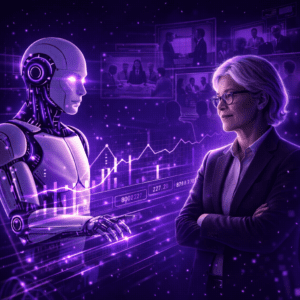 Another powerful distinction between Artificial Intelligence versus Human Intelligence lies in how each learns. Artificial intelligence learns from data. Models improve as they process more examples, more signals, and more outcomes.
Human intelligence learns differently. Humans learn through experience. A leader who has navigated a crisis understands dynamics that no spreadsheet can fully represent. Someone who has led teams through failure remembers the emotional impact of those moments and the lessons that followed. Experience shapes judgment.
Failure also plays an essential role. Organizations often treat failure as something to avoid, yet human intelligence develops precisely because individuals reflect on mistakes. People remember how a poor decision affected colleagues, customers, or reputations. Artificial intelligence records outcomes while humans remember consequences.
Reflection completes the process. Humans can pause to think about what happened, why it happened, and what should change next time. This reflective capability creates wisdom, something far more complex than data. In the conversation about Artificial Intelligence versus Human Intelligence, this learning cycle remains deeply human.
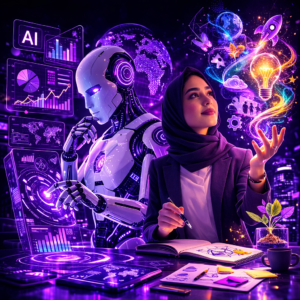 Artificial intelligence can generate variations of existing ideas. It can recombine patterns from training data and produce outputs that resemble creativity. Yet true creativity often requires something different. It requires imagining something that has never existed before.
This distinction is critical when exploring Artificial Intelligence versus Human Intelligence. Innovation frequently emerges from unexpected questions rather than optimized answers. Leaders who challenge assumptions, experiment with unusual ideas, or pursue unconventional strategies often generate breakthroughs. Machines rarely initiate those leaps.
A dataset might suggest incremental improvements, while human imagination asks whether the entire system should be redesigned. Consider many of the ideas that transformed organizations. Customer experiences reimagined around empathy. Corporate cultures redesigned around trust. Entire industries are reshaped by unconventional thinking.
These moments rarely originate from algorithms. They originate from human curiosity. Artificial intelligence can analyze the past with extraordinary precision, yet humans imagine possibilities beyond it.
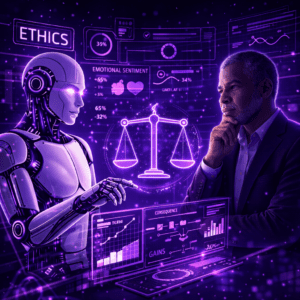 Perhaps the most important dimension of Artificial Intelligence versus Human Intelligence involves ethics. Artificial intelligence can detect emotional language in customer messages. It can analyze tone during conversations and identify sentiment patterns. Yet recognizing emotion is not the same as experiencing it.
Humans feel responsibility. Leaders must consider consequences that extend beyond efficiency. Decisions affect people, communities, and reputations. Ethical judgment requires empathy, perspective, and moral reasoning, qualities that cannot be fully automated.
Intuition also plays a role. Experienced leaders sometimes sense that something is wrong even when data appears stable. They detect subtle signals during conversations or organizational interactions that indicate deeper problems. These instincts often emerge from years of experience and reflection.
Artificial intelligence processes signals while humans sense meaning within them. Organizations that ignore this dimension of Artificial Intelligence versus Human Intelligence risk delegating decisions that require human responsibility.
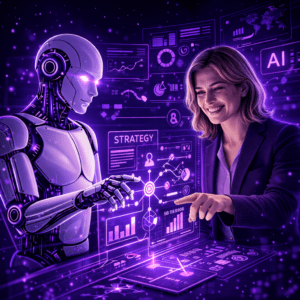 The most productive way to understand Artificial Intelligence versus Human Intelligence is not as a rivalry. It is a collaboration.
Artificial intelligence offers capabilities that amplify human performance. Faster analysis, improved pattern recognition, and predictive insights allow organizations to see risks and opportunities earlier. Human intelligence ensures that these insights translate into wise decisions.
Leaders ask questions that algorithms cannot answer. What truly matters in this moment? What consequences might this decision create for people? What long-term values should guide this choice? These questions transform information into strategy.
The future of leadership will therefore not be defined by competing with artificial intelligence on speed or data processing. It will be defined by combining machine intelligence with human judgment.