AI and Job Anxiety: What Organizations Must Understand When Employees Worry About the Future

Share This Post

AI and Job Anxiety: The Organizational Challenge Hidden Behind AI Adoption

Walk through many organizations right now, and you will notice something subtle but important. Artificial intelligence enters a conversation, and the reaction in the room shifts. Some people lean forward with excitement. Others become thoughtful and quiet. A few ask careful questions about efficiency, productivity, or automation. On the surface, these questions sound technical. Beneath them often sits something much more human. Uncertainty.

Across industries, AI and job anxiety are increasingly appearing together in the same sentence. Not because employees reject innovation, but because major technological shifts inevitably raise questions about relevance, stability, and the future of work. In many companies, this anxiety rarely shows up as open resistance. Instead, it appears in quieter ways. Employees hesitate to experiment with new tools. Teams delay adopting AI-supported workflows. Some professionals become cautious about sharing knowledge, worried that automation might eventually replace what they know.

From an organizational perspective, this emotional reaction matters more than most leaders initially realize. Technology transformations succeed or fail less because of software and far more because of how people feel about using it. When organizations ignore AI and job anxiety, uncertainty begins to shape behavior across teams. People protect their roles rather than expand them. Innovation slows because experimentation feels risky. Collaboration weakens as employees quietly compete to remain indispensable.

Yet when organizations acknowledge these fears openly, something different happens. Employees begin to see AI less as a threat and more as a tool. Curiosity replaces hesitation. Conversations shift from “Will this replace me?” to “How can this help us?” Understanding AI and job anxiety is, therefore, not just a human resources issue. It is an organizational leadership challenge that determines how effectively companies adapt to technological change.

KEY TAKEAWAYS

  • AI and job anxiety often arise from uncertainty about future roles
  • Employees worry about relevance more than about technology itself
  • Silence inside organizations allows anxiety to spread quickly
  • Clear communication stabilizes teams during technological change
  • AI reshapes tasks but rarely eliminates the need for human judgment
  • Organizations must help employees redefine how they create value
  • Safe experimentation reduces fear and builds confidence with AI tools
  • Addressing anxiety early accelerates adoption and innovation

Why AI Triggers Job Anxiety Inside Organizations

The connection between AI and job anxiety rarely begins with algorithms or technical capability. It begins with identity.

For years, professionals have developed expertise that defines their value within an organization. They learn complex processes, accumulate institutional knowledge, and become trusted contributors whose judgment matters in critical moments. Then a new technology appears that can analyze information, generate reports, summarize meetings, and even propose decisions within seconds.

Naturally, a question arises. If a system can perform some of these tasks faster, where does that leave the person who once performed them? This reaction is not irrational. It reflects a deeply human instinct to protect one’s professional relevance. Employees want to know that the skills they invested years developing will still matter tomorrow.

Understanding the relationship between AI and job anxiety requires recognizing this emotional layer. People rarely fear technology itself. They fear becoming unnecessary within the systems they helped build. Organizations that acknowledge this concern directly create space for constructive dialogue. Instead of dismissing the anxiety, they address it with clarity and context.

How Job Anxiety Spreads Across Teams

Inside organizations, emotions move quickly. A single comment about automation during a meeting. A rumor about AI replacing certain tasks. An article shared in a team chat discussing layoffs connected to new technologies. Soon, the conversation about AI and job anxiety spreads through informal channels faster than any official communication.

Employees begin interpreting ordinary changes through a lens of uncertainty. A request to test an AI tool feels like preparation for replacing human work. A new efficiency initiative sounds like a cost reduction strategy focused on headcount. Even neutral organizational decisions can trigger speculation.

When leaders remain silent about technological change, employees often create their own explanations. These explanations tend to be far more dramatic than reality. The result is not open resistance but quiet hesitation. Teams slow down adoption. Employees protect information rather than sharing it. Innovation becomes cautious.

Organizations that want AI adoption to succeed must therefore address the emotional conversation surrounding it. Transparency reduces speculation. Clarity stabilizes teams. When employees understand the purpose behind AI initiatives, anxiety begins to shrink.

When Job Anxiety Turns Into Silent Resistance

Most organizations assume that if employees fear new technology, they will openly challenge it. In reality, the opposite often happens. Anxiety rarely announces itself in dramatic ways. Instead, it quietly reshapes behavior.

When AI and job anxiety circulate within an organization, employees rarely stand up in meetings to say they are worried about the future. What they do instead is far more subtle. They delay experimenting with new tools. They ask for “a little more time” before implementing automation. They continue using familiar workflows even when faster alternatives are available.

From a leadership perspective, this behavior can easily be misinterpreted. It may look like a productivity issue, a training gap, or even simple resistance to change. But beneath the surface, something else is happening. People are protecting their professional identity. When employees feel uncertain about how AI may reshape their work, they instinctively begin preserving the expertise that once defined their value. Knowledge becomes something to guard rather than something to share. Collaboration quietly weakens because individuals want to remain indispensable.

This is how job anxiety transforms into what could be called “silent resistance.” Nothing appears confrontational. Yet innovation slows, experimentation decreases, and organizational learning becomes cautious. Ironically, the more organizations push AI adoption without addressing the human concerns behind it, the more this silent resistance tends to grow. Employees comply with the change on paper while hesitating in practice.

Organizations that recognize this pattern early respond differently. Instead of interpreting hesitation as opposition, they treat it as a signal that deeper conversations are needed. Leaders begin discussing how work will evolve, what new opportunities technology may create, and where human contribution becomes even more valuable.

When employees see that their future still includes meaningful roles, hesitation begins to dissolve. Curiosity replaces caution. Experimentation returns. In many ways, the challenge is not the technology itself. It is whether organizations understand the human reaction that often appears before people learn how to work alongside it.

Why High Performers Often Feel the Most AI Anxiety

One of the most surprising aspects of AI and job anxiety is that it often affects the strongest performers first. Leaders sometimes expect hesitation from employees who struggle with change or lack confidence in their roles. Yet inside many organizations, the people asking the most thoughtful questions about artificial intelligence are the same individuals who have historically delivered the most value.

The reason is simple. High performers tend to build their professional identity around expertise. Over years, sometimes decades, they develop deep knowledge about systems, processes, relationships, and industry patterns. They become the people others consult when a complex problem appears or a difficult decision must be made. Their confidence comes not from job titles but from the trust they have earned through experience.

When AI tools suddenly perform tasks that once signaled expertise, such as summarizing reports, generating insights, and organizing complex information, the shift can feel unsettling. Work that once required years of accumulated experience may now appear on a screen in seconds. For many high performers, the question is not simply whether AI will change their job. It is whether the expertise that once defined their value will still matter.

This is why AI and job anxiety often show up first among those who care most deeply about excellence. They are not resisting innovation. They are trying to understand how their contribution evolves in a world where information becomes instantly accessible. Organizations that recognize this dynamic respond thoughtfully. Instead of dismissing concerns, they help employees reframe expertise itself. Experience does not disappear when technology improves. It transforms.

While AI can generate information quickly, experienced professionals still interpret what that information means in context. They recognize subtle risks hidden inside data. They understand the human relationships behind decisions. They know when to follow a recommendation and when to question it.

When organizations communicate this distinction clearly, high performers often become the strongest advocates for new technology. Once they see how artificial intelligence can amplify their judgment rather than replace it, their initial anxiety frequently turns into leadership. And when that shift happens, the same people who once worried about the technology often become the ones guiding everyone else through it.

The Organizational Opportunity Hidden Inside Anxiety

Interestingly, the presence of AI and job anxiety can signal something positive. It indicates that employees care deeply about the future of their work.

Periods of technological disruption often force organizations to reconsider fundamental questions. Which activities truly create value? Which processes exist simply because technology once required them? Where do human skills provide advantages that automation cannot replicate?

Artificial intelligence is particularly effective at removing repetitive tasks that consume large portions of many workdays. Administrative preparation, data formatting, routine reporting, and information retrieval. When these activities shrink, space opens for something else. Strategic thinking. Creative problem solving. Relationship building. Collaboration across teams. Interpretation of complex situations.

In other words, organizations often discover that AI does not eliminate meaningful work. Instead, it shifts attention toward more human contributions. Companies that communicate this shift clearly help employees see the opportunity behind the change. Instead of focusing on what disappears, teams begin focusing on what becomes possible.

How Organizations Can Reduce AI and Job Anxiety

Addressing AI and job anxiety requires more than technical training programs. The challenge is cultural and psychological as much as it is technological. Organizations that navigate this transition successfully tend to take deliberate actions to guide employees through the change. Here are some practical approaches that help reduce anxiety while encouraging thoughtful adoption of artificial intelligence.

AI and Job Anxiety 1When organizations begin discussing artificial intelligence only after tools are introduced, employees often feel surprised or unprepared. Starting the conversation early helps people process change gradually. Even acknowledging that leadership is still exploring possibilities can reduce anxiety because employees see transparency rather than secrecy.

AI and Job Anxiety 2Employees often assume automation exists primarily to reduce headcount. Organizations that explain the strategic goals behind AI initiatives create a different narrative. When teams understand that technology aims to improve insight, speed, and service quality, the relationship between AI and job anxiety begins to shift.

AI and Job Anxiety 3One of the most effective ways to reduce uncertainty is to describe how tasks may change rather than leaving employees to imagine the worst. When organizations explain that automation may remove repetitive work while expanding analytical or strategic responsibilities, employees gain a clearer picture of their future role.

AI and Job Anxiety 4Anxiety tends to decrease once people interact with unfamiliar tools. Creating opportunities for employees to experiment with AI systems without pressure allows curiosity to replace hesitation. The goal is not mastery but familiarity.

AI and Job Anxiety 5As artificial intelligence becomes more capable, the value of human abilities increases. Communication, judgment, empathy, leadership, and creativity remain difficult for machines to replicate. Organizations that invest in developing these skills signal that human contribution remains central to their strategy.

AI and Job Anxiety 6Many employees avoid experimenting with AI because they fear making mistakes. Leaders who reward learning instead of flawless execution create a culture where people feel comfortable exploring new capabilities. Progress matters more than expertise during technological transitions.

AI and Job Anxiety 7Stories influence organizational culture. When teams see colleagues using AI to improve their work, automate tedious tasks, or discover new insights, technology begins to feel practical rather than threatening. Concrete examples are far more persuasive than abstract promises.

AI and Job Anxiety 8Every organization ultimately exists to serve people, whether clients, customers, patients, or communities. Artificial intelligence may support the work, but it does not replace the purpose behind it. Reconnecting employees with that mission helps place technological change in a broader perspective.


The Organizational Future in an AI Enabled World

The relationship between AI and job anxiety will likely appear in many workplaces over the coming years. Technological progress naturally raises questions about identity, value, and contribution. Employees want reassurance that their work continues to matter.

Organizations that acknowledge these concerns openly create environments where adaptation happens faster and more thoughtfully. Instead of forcing technological change upon uncertain teams, they guide employees through the transition with clarity and support. Over time, something remarkable occurs. Employees who once hesitated to experiment with AI begin discovering how it strengthens their work. They automate repetitive tasks, generate insights faster, and spend more energy on complex challenges that require human thinking.

The technology does not erase their value. It reframes it. Artificial intelligence will undoubtedly reshape many processes inside organizations. Yet the future of work will still depend on people who understand context, interpret meaning, and make thoughtful decisions. Machines may analyze information quickly. But organizations still rely on humans to decide what truly matters.

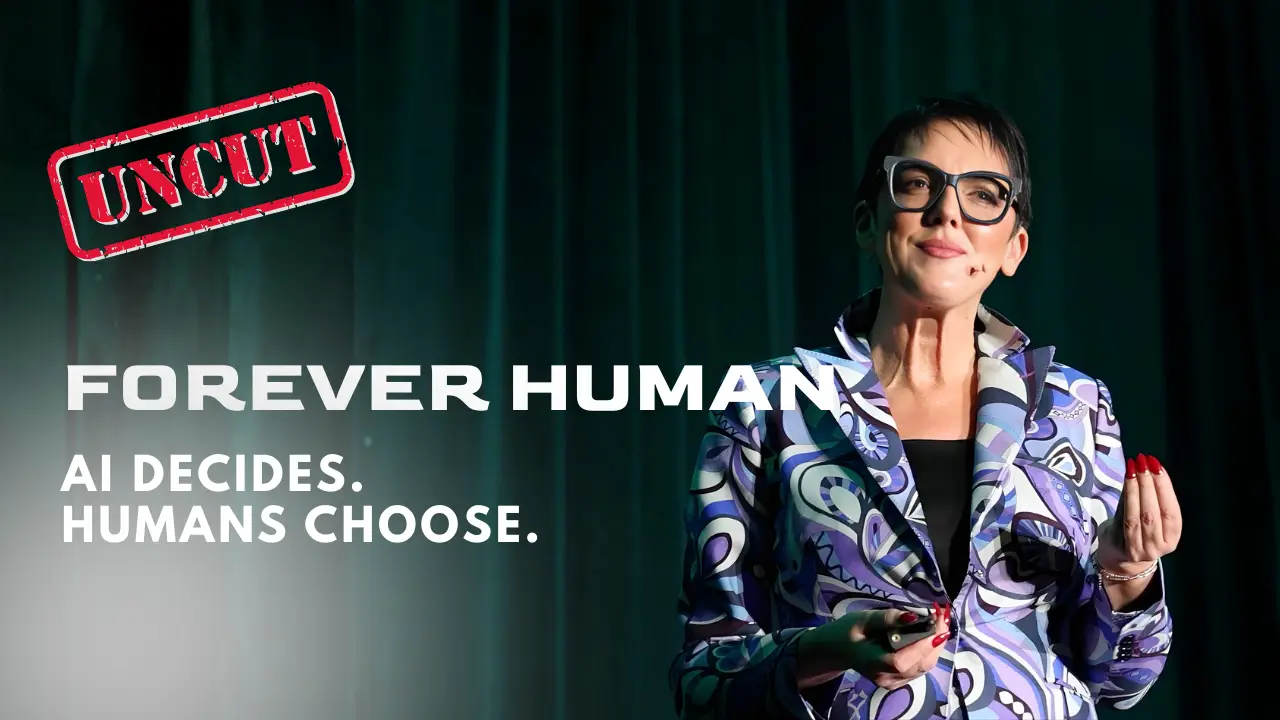
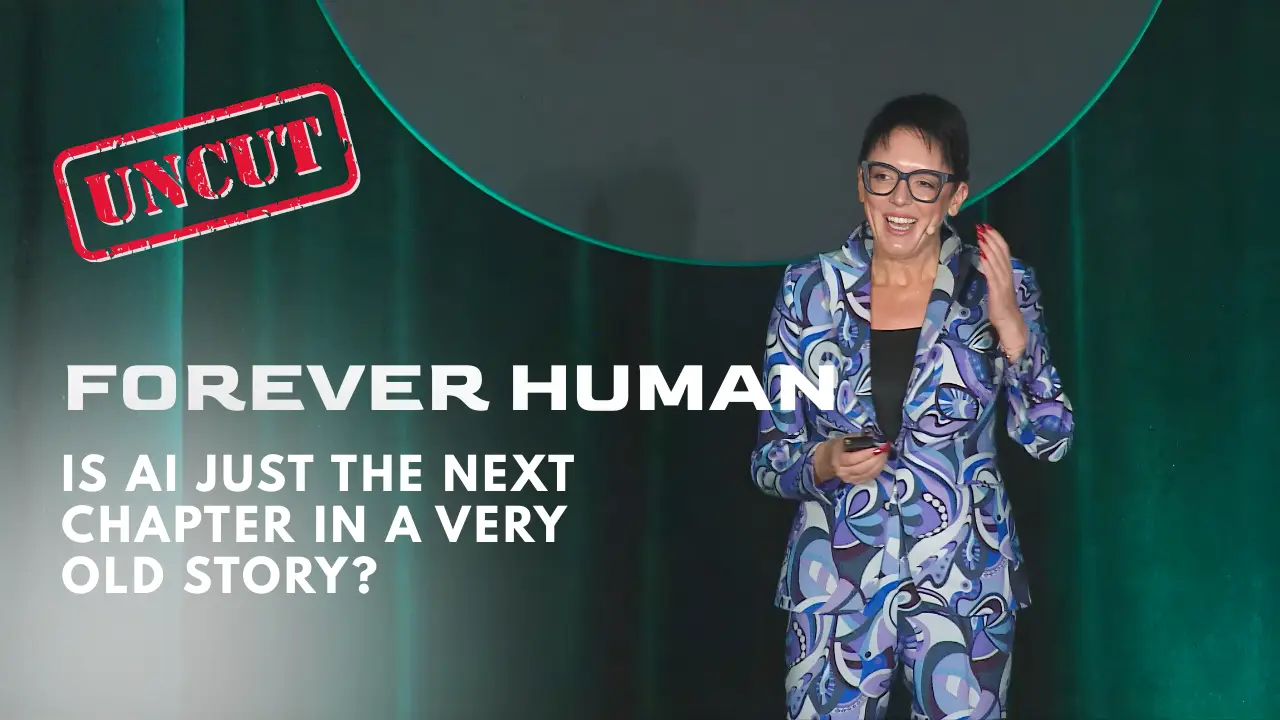
Hall of Fame keynote speaker Sylvie di Giusto examines the human dynamics behind artificial intelligence in her keynote Forever Human. Rather than focusing on the mechanics of the technology itself, she explores how AI influences the way people experience work, make decisions, and think about their future inside organizations. As new tools enter the workplace, many employees quietly question what these changes mean for their expertise and long-term relevance. Sylvie helps leaders recognize that the real challenge of AI adoption is rarely technical. It is human. When organizations understand the emotions that accompany innovation, they can guide their teams through uncertainty and build a more confident relationship with emerging technology.

Sylvie di Giusto, AI Keynote Speaker, Speed of AI

Sylvie di Giusto is a Hall of Fame keynote speaker who explores what happens to people when technology changes the way we work. Known for creating the world’s first fully immersive 3D keynote experiences, she brings audiences inside the human side of artificial intelligence. Rather than focusing on algorithms or software, Sylvie examines how AI reshapes trust, leadership, decision-making, and the way professionals create value inside organizations. Her keynotes challenge leaders to look beyond the technology itself and understand the behavioral shifts that accompany it. As she often reminds audiences, the real conversation about AI is not about machines. It is about humans. Sylvie is represented worldwide by the speaker management agency cmi. To inquire about her availability, reach out to her team.

More To Explore