AI and Customer Expectations | When “Fast Enough” No Longer Exists

Share This Post

The End of Customer Patience | AI and Customer Expectations

There was a time when customers were used to wait. They waited for a sales associate to call back. They waited several days for shipping. They waited while a company “looked into the issue.” Waiting was inconvenient, but it was normal. It was simply part of doing business.

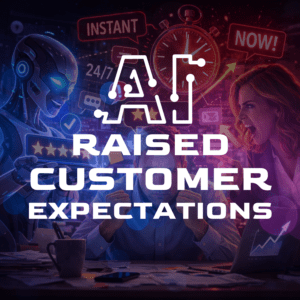
Artificial intelligence is quietly erasing that tolerance. The relationship between AI and customer expectations is transforming how people evaluate service, communication, and value. When technology can answer questions instantly, track deliveries in real time, and personalize recommendations within seconds, customers begin assuming that every interaction should happen at that same speed.

This shift has nothing to do with impatience as a personality trait. It is a structural change in behavior. When technology demonstrates that something can happen instantly, the brain quickly concludes that it should happen instantly. Organizations that understand the behavioral impact of AI and customer expectations are discovering a powerful truth. The companies winning customer loyalty are not simply the fastest ones. They are the ones that understand how speed shapes perception.

KEY TAKEAWAYS

  • AI is redefining what “good service” means
  • Instant responses raise the baseline for every customer interaction
  • Delays now feel like failures, even when they are reasonable
  • Customers compare every brand to the fastest experience they’ve had
  • AI accelerates service, but clarity and trust still build loyalty
  • Businesses must design experiences around modern expectations
  • Transparency can replace speed when speed is impossible
  • Companies that understand AI and customer expectations build stronger relationships

The New Baseline: Instant Everything

Customers rarely compare you to your direct competitors anymore. They compare you to the fastest experience they had this week. That might be a streaming service that loads instantly, an online store that delivers tomorrow, or a chatbot that answers questions in seconds. These experiences recalibrate the brain. Once someone has experienced speed, their expectation resets.

This is the central shift created by AI and customer expectations. Artificial intelligence allows companies to automate responses, analyze behavior, and personalize interactions in real time. As more organizations adopt these capabilities, the definition of “responsive service” continues to change. A reply within hours once felt impressive. Now it can feel slow. A delivery within a week once felt efficient. Now it feels delayed.

This does not mean every organization must match the speed of the largest technology companies. But it does mean customers now judge every experience against a new mental benchmark. The question businesses must ask is no longer simply “How fast are we?” The more relevant question is “How fast do customers believe we should be?” Understanding AI and customer expectations begins with recognizing that perception often matters more than raw speed.

When Silence Feels Suspicious

One of the most subtle effects of AI-powered technology is how it changes our interpretation of silence. Consider messaging apps. A typing indicator appears. The other person is clearly responding. Then it disappears. Even if the pause lasts only a few seconds, it suddenly feels uncomfortable. Something must be wrong. Nothing actually happened. Yet the visible expectation of speed changed how the delay feels.

This dynamic appears constantly in customer relationships. If a support ticket receives no acknowledgment, customers assume it was ignored. If an order confirmation does not arrive immediately, they begin wondering whether the purchase actually worked.

The psychology behind AI and customer expectations reveals why this happens. When technology shows us that information can move instantly, any delay begins to feel like a breakdown in the system.

Companies that understand this principle do something simple but powerful. They communicate quickly, even when the solution itself takes longer. An immediate confirmation message. A progress update. A transparent explanation of what is happening behind the scenes. Speed in communication can often compensate for slower processes. Customers do not always require instant solutions. But they increasingly require instant reassurance.

Customers Now Expect Businesses to Anticipate Needs

Artificial intelligence has introduced another shift that many companies underestimate. Customers increasingly expect businesses to anticipate what they need before they ask. Recommendation engines suggest products based on past purchases. Streaming platforms predict what someone wants to watch next. Travel apps alert users when prices change. These experiences subtly train customers to expect proactive service.

This is another powerful dimension of AI and customer expectations. The best customer experience no longer feels reactive. It feels predictive. Otherwise, customers begin wondering why companies did not anticipate obvious issues. Why was there no reminder before a subscription renewed? Why was there no warning about a shipping delay? Why did the company wait until the customer complained to solve the problem?

Organizations that succeed in this new environment treat AI not just as an efficiency tool, but as an anticipation tool. They analyze patterns, detect potential friction points, and communicate with customers before frustration emerges. In a world shaped by AI and customer expectations, preventing a problem often creates a stronger impression than solving one.

The Real Reason Customers Become Less Patient

It is tempting to believe customers have simply become more demanding. The reality is more nuanced. Technology has compressed the time between desire and fulfillment. Music plays instantly. Information appears immediately. Food can arrive within minutes. When people experience this level of responsiveness repeatedly, their perception of “reasonable waiting” changes.

Humans are remarkably adaptive. Our expectations quickly adjust to new norms. What once felt impressive soon becomes ordinary. A company that once delighted customers with two-day delivery now competes with services promising same-day shipping.

The challenge for organizations is not simply keeping up with speed. It is understanding how quickly expectations evolve. Businesses that study AI and customer expectations treat customer patience as a dynamic variable rather than a fixed trait. They continually reassess how their experience feels from the customer’s perspective.

Designing Experiences That Match Modern Customer Expectations

Companies cannot control how quickly technology evolves. But they can control how thoughtfully they design the customer experience. Understanding AI and customer expectations allows organizations to create systems that feel responsive even when processes require time. Here are a few ideas:

AI and Customer ExpectationsThe moment a customer reaches out, uncertainty begins. Automated confirmations, instant acknowledgments, or short responses signal that the company is attentive and organized. Even if the final answer takes time, early recognition reassures customers that they have been heard.

AI and Customer ExpectationsWaiting becomes far more tolerable when people understand the process. Clear explanations about timelines, next steps, and responsibilities remove ambiguity. Customers may still need patience, but they no longer feel lost in the process.

AI and Customer ExpectationsTracking tools, real-time updates, and delivery timelines transform waiting into something measurable. When customers can see progress, they feel included rather than ignored. Transparency turns passive waiting into active understanding.

AI and Customer ExpectationsMany customer frustrations come from simple obstacles such as long menus, repeated information, or slow routing. AI-powered chatbots, intelligent call routing, and automated knowledge bases can resolve common issues instantly. Removing small barriers dramatically improves the perceived experience.

AI and Customer ExpectationsThe most impressive customer experiences feel proactive. When businesses notify customers about potential delays, upcoming renewals, or order updates before the customer asks, trust increases dramatically. Anticipation signals competence and care.

AI and Customer ExpectationsCustomers judge experiences not only by speed but by effort. If solving a problem requires multiple emails, repeated explanations, or complicated forms, frustration grows quickly. Streamlining resolution processes reduces emotional friction.

AI and Customer ExpectationsAI allows organizations to recognize individual behavior patterns and preferences. Addressing customers by name, referencing previous interactions, and tailoring recommendations makes the experience feel thoughtful rather than mechanical. Personalization transforms transactions into relationships.

AI and Customer ExpectationsCustomers become frustrated when reality differs from what they imagined. Clear communication about delivery times, support availability, or service limitations prevents disappointment. Honest expectations often matter more than perfect speed.

AI and Customer ExpectationsSpeed attracts attention, but trust builds loyalty. Organizations that focus exclusively on fast responses sometimes overlook clarity, empathy, and reliability. When businesses combine responsiveness with credibility, customers remain loyal even when things take time.

AI and Customer ExpectationsAutomation can deliver speed, but human interaction delivers reassurance. Customers often appreciate quick answers, yet they still want empathy when issues become complex or emotional. Combining intelligent systems with human understanding creates a stronger impression.
Organizations and leaders that adopt these practices discover the real promise behind human behavior and AI. Artificial intelligence accelerates access to information, while human leaders ensure that information is used wisely.

Why This Shift Matters for Every Industry

Customers now arrive with expectations shaped by their fastest digital experiences. This means e.v.e.r.y industry must reconsider what responsiveness looks like. The organizations that thrive in this environment treat customer expectations as a moving target. They observe how behavior evolves and redesign experiences accordingly.

Artificial intelligence will continue raising the standard for convenience, speed, and personalization. Businesses that understand these changes early gain a powerful advantage. They stop reacting to customer frustration and start designing experiences that prevent it.

Hall of Fame keynote speaker Sylvie di Giusto explores these shifts in her immersive keynote Forever Human, where audiences experience how artificial intelligence is redefining speed, perception, and the expectations customers bring to every interaction. Organizations that understand the connection between AI and customer expectations can design experiences that feel faster, smarter, and more human.

Explore the keynote that machines will never deliver.

Sylvie di Giusto, AI Keynote Speaker, Speed of AI

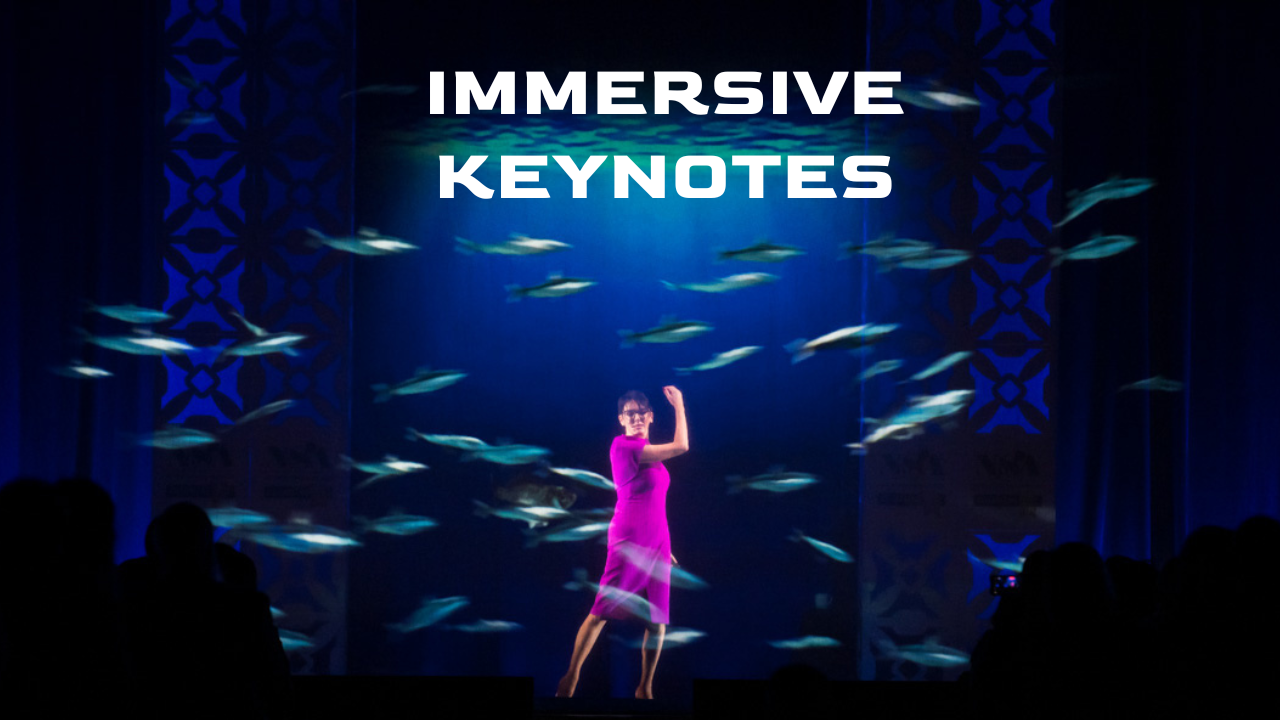
Hall of Fame keynote speaker Sylvie di Giusto is known for pioneering the world’s first 3D immersive keynote experiences. Her work explores how emerging technologies, including artificial intelligence, are reshaping human behavior, customer expectations, and the way organizations build trust. Through powerful visuals and behavioral insights, she helps audiences understand how people think, decide, and respond in a technology-driven world. Sylvie is proudly represented by the global speaker management agency cmi. To inquire about her availability, reach out to her wonderful team.

LATEST INSIGHTS

ABOUT THE AUTHOR

Sylvie di Giusto, CSP, CPAE, is a multi-award-winning international Hall of Fame keynote speaker who explores how artificial intelligence is reshaping human behavior. Unlike other AI keynote speakers, she approaches the topic through a human lens, examining how leadership and client relationships evolve as machines grow more capable.

BRING FOREVER HUMAN TO your evenT

Looking for an AI keynote speaker who doesn’t give a tech talk, but a people talk?

Forever Human

THE AI KEYNOTE ABOUT HUMANS

Immersive 3D keynotes by Sylvie di Giusto

EXPERIENCE THE MAGIC

*Available as either a 3D immersive keynote experience or a traditional keynote format.

More To Explore

UNCUT. UNFILTERED.

THE SPEED SHIFT

THE ATTENTION ECONOMY

THE WISDOM GAP

THE FEAR OF THE NEW

Uncut - Video 4 - Forever Human

THE TRUST CRISIS

THE SPEED TRAP

THE HUMAN OVERRIDE

Uncut - Video 1 - Forever Human

THE DISRUPTION CYCLE