Future of Retail: When AI Becomes Your Customer's Shopper
A brand director discovers that their product has been quietly replaced in a customer’s AI rotation by a competitor’s. No marketing intervention worked. The customer never even knew it happened. That moment is the future of retail arriving in real time, and it is happening to more brands right now than most retail leaders are prepared to admit. Your customer’s shopping happens inside a system you cannot directly access, and the rules of engagement are not the rules you learned.
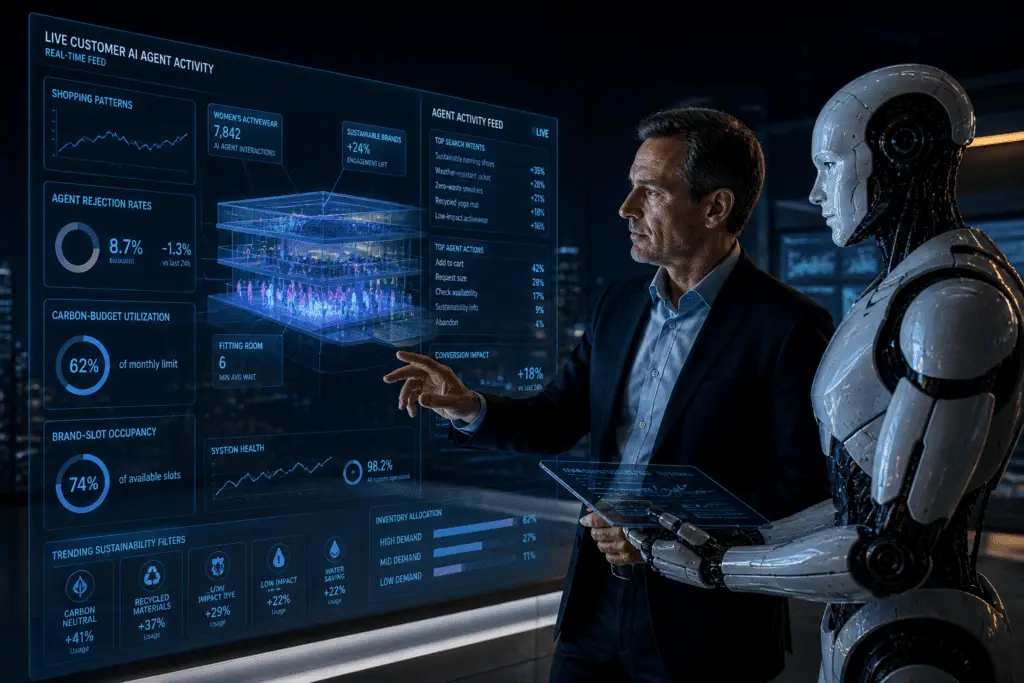
Here is what the data actually shows. 80% of everyday retail decisions are being moved to customer AI agents. Shopify Sidekick, Amazon anticipatory systems, OpenAI Operator—none of that is coming. It is shipping this year. These systems do not care about your advertising. They care about the customer’s stated preferences. When your product no longer fits those preferences, the customer never even notices the substitution.
This article is for the retail executive, brand director, or strategy lead who feels the structure shifting and needs to know what the positioning window actually requires. Not in 2049. Now. The retailers building algorithmic positioning capability while the rest are still defending shelf space will be the ones the industry follows when the agent layer becomes the only customer access that matters.
KEY TAKEAWAYS
- By 2050, eighty percent of retail decisions will happen inside customer AI agents. Direct customer access becomes the exception, not the rule.
- Brands stop competing for customers. They compete for algorithmic slots; the recurring rotations inside someone else’s decision system.
- Your traditional marketing channels become invisible to a customer whose AI filters the commercial layer entirely. New positioning rules apply.
- Attention gets regulated like pollution. Your customer has 30 minutes of commercial exposure daily across all brands and all channels. You have to earn your share.
- Carbon and resource caps are automatically embedded in AI purchasing decisions. Products that exceed the household carbon budget are rejected before the customer even knows they exist.
- Human-only retail spaces emerge in response to algorithmic dominance, but only wealthy customers can afford the inefficiency of direct choice.
- The retailer who survives 2050 is the one who moved from volume pushing to limited design, from shelf optimization to algorithmic positioning.
When Your Customer Stops Being a Shopper
Throughout the modern retail era, the assumption was that customers shop. The customer compares options, makes selections, and chooses between alternatives. That assumption is ending. By 2050, the customer sets preferences once, and a personal AI agent handles the rest for years. The customer does not experience a choice set. The customer experiences defaults.
This breaks the entire foundation of retail. The brand built on shelf visibility disappears. The marketing campaign designed to influence choice becomes invisible. The in-store experience that once drove impulse purchases becomes irrelevant when AI never brings customers into the store. A retail executive asked to defend the brand portfolio will increasingly find themselves explaining why the customer’s AI agent should give the brand space in its rotation, not why the customer should choose the brand when they shop.
The uncomfortable truth: retailers do not lose the customer. They lose access to the customer. The customer is still there. They are just shopping through a system that the retailer cannot interface with directly. That changes everything about how you think about competitive positioning.
When your customer delegates shopping to an algorithm, you start pitching for a slot inside the system the customer trusts.
Sylvie di Giusto
The Slot Economy: What Actually Gets Bought
The question is no longer “how do I make my product attractive to customers?” It is “how do I keep my product in the regular rotation of a decision system I do not control?” That shift is so fundamental that most retail organizations have not even named it yet, let alone built capability around it.
The brand that wins a recurring rotation slot inside a customer AI system gets the revenue. The brand that loses the slot has no path back until the agent’s logic changes, which happens on a timeline the brand cannot accelerate. There are no marketing interventions available. There is no promotional tactic. There is no in-store display that influences the decision. The slot is lost inside an algorithm, and the only way to recover it is to make yourself so valuable to the agent’s decision logic that it recalculates your position.
This produces a cascading implication that most retail teams have not yet worked through. Your competitive position is no longer defined by customer preferences. It is defined by algorithmic positioning. How well your product data integrates into the agent’s recommendation engine. How consistently you deliver on the attributes the agent was instructed to optimize. How quickly you respond when an attribute the agent cares about changes. The brands that move from customer emotional loyalty to understanding the politics of algorithmic systems are the ones that will hold their slots.
The slot is the only thing that matters. Win it. Lose it. The customer never knows the difference, and neither do you until the revenue disappears.
Sylvie di Giusto
When Attention Becomes a Regulated Budget
Attention is becoming a regulated public health resource. Cognitive overload is increasingly framed as a societal harm. Some jurisdictions are already piloting attention regulation in the way they regulate industrial pollution. Customer AI agents shield their owners from most marketing exposure. The future customer may have 30 minutes of total commercial exposure per day, across all brands and channels, globally.
That constraint reshapes every retail logic. More impressions become a losing strategy. Cheaper clicks become irrelevant. The brand that can earn three minutes of genuine attention from a customer who has twenty-seven minutes remaining for the entire commercial economy will be the brand that builds long-term loyalty. The brand that tries to optimize for impression volume will be filtered out before the impression ever lands.
The leadership question shifts radically. When attention is scarce and regulated, what is your brand actually worth to the customer’s time? And what will you do with the attention you get when you get it?
Attention is the only finite resource that matters in the future.
Sylvie di Giusto
Planetary Budget Becomes the Real Constraint
Hard resource caps are moving from sustainability marketing claims to operational reality across consumer goods. Products will increasingly carry verified impact data. Customer AI agents will refuse purchases that break the household carbon budget. That shifts the constraint from cost to planetary allowance, and retail organizations that have not developed the literacy to operate within that constraint will spend the next decade in crisis-management mode.
Hard resource caps are moving from sustainability marketing claims to operational reality across consumer goods. Products will increasingly carry verified impact data. Customer AI agents will refuse purchases that break the household carbon budget. That shifts the constraint from cost to planetary allowance, and retail organizations that have not developed the literacy to operate within that constraint will spend the next decade in crisis-management mode. France is already rolling out eco-scores for consumer goods. The EU is following. Customer agents will track aggregate household impact and automatically decline purchases.
The implication: you have to rebuild every product decision through the lens of verified impact. Supply chain sourcing. Manufacturing process. End-of-life takeback. The brands that integrate this deliberately will become agent-friendly. The ones that resist will gradually disappear from customer AI rotations.
Your product will be refused by AI if the impact tag fails a consumers household carbon budget.
Sylvie di Giusto
Virtual Worlds Are Where the Emotional Life Happens
Another shift is the migration of emotional and aesthetic life into persistent digital environments. People own virtual homes. Virtual clothing. Virtual status. Virtual social experiences. Retail follows. Every product exists in physical and digital versions. Some brands exist only as avatars. The competitive logic that built physical luxury does not transfer to places where anything can be created instantly. Different rules apply entirely.
The retail leadership that recognizes this early invests in a synthetic-world brand strategy now. The leadership that treats virtual goods as a niche curiosity will watch its share of customers’ emotional lives shrink without an obvious replacement. The skill set required is part creative and part philosophical. If half your customers’ emotional life exists in a place where anything can be created instantly, what are you actually selling? Connection? Community? Identity? The answer is not the same as it was for physical retail.
When your customer's life happens in a place where anything can be created instantly, you are selling meaning.
Sylvie di Giusto
The Skills That Do Not Depreciate
Some parts of retail leadership AI cannot provide structurally. Not because the technology is too primitive, but because the role itself is not what algorithms are built for. Naming these categories sharply is what lets leaders invest in skills that appreciate instead of depreciate.
AI cannot decide what your brand will refuse to sell. It can optimize against any goal you give it. The choice of what is unacceptable is human, contested, or political.
AI cannot design a ritual that builds belonging across years. It can recommend touchpoints. The cumulative emotional architecture of a brand relationship is human work.
AI cannot defend a refusal under shareholder pressure. The discipline to say “yes, we can, but we will not” is a leadership commitment that cannot be delegated to a model.
These three categories are where the retail leader’s human edge will compound. None are taught in standard merchandising curricula. All define the future of retail at the leadership level. The leader who invests in these categories now becomes the one who understands what AI fundamentally cannot replace in the human professional, and that understanding compounds into positioning the rest of the industry will have to follow.
Deciding what to refuse. Building belonging rituals. Standing firm under pressure.
Sylvie di Giusto
What Four Conversations Are About to Land
Four conversations are about to land at every retail leader’s door, and the ones who can hold them with substance will become the trusted voices of the next decade. Those who deflect will find that the substantive questions are taken up by others, including regulators, journalists, and customer AI vendors who do not need permission to ask.
First, what slot does your brand hold inside customer AI agents, and how is that slot being defended? Boards will want this answered.
Second, when your optimization engine could push a vulnerable customer toward an impulse purchase, what is your firm’s policy? Regulators are asking.
Third, how does your supply chain stand up to verified impact audits? Customer AI will increasingly enforce this.
Fourth, what is your position on synthetic-world commerce? Your physical operations cannot enter those environments, but your brand can.
You can prepare for these conversations or be surprised by them. Either way, they are arriving on a timeline shorter than most retail planning cycles accommodate.
The leaders who prepare will hold the conversation with substance. The ones who do not will be filtered out.
Sylvie di Giusto
The future of retail is not a 2050 problem. It is a NOW reality showing up in agentic commerce launches, customer AI-substitution patterns, attention-regulation pilots, eco-score rollouts, and synthetic-world brand strategy. The work in front of every leader is to make the deliberate move from volume pushing to algorithmic positioning, build the skills AI structurally cannot occupy, prepare for the four conversations stakeholders are about to have, and invest in the human-edge categories.
None of this is exotic. All of it is available to every retail leader starting today. The future of retail will be defined by the small group that recognized this period as a positioning window and used it. The window is open now. It will not stay open indefinitely, and the early movers know it.
Frequently asked questions
What will the future of retail look like by 2050?
Most everyday shopping decisions disappear into customer AI agents. Customers set preferences once. The agent handles everything else for years. Retailers stop selling to customers. They sell slots inside customer AI systems. Brands become lines in algorithms, not logos on shelves. Attention gets regulated like industrial pollution. Carbon and resource caps embed in transactions automatically. A counter-movement of human-only spaces emerges where people practice direct choice. The future of retail is no longer about merchandising. It is about designing experiences human-centered systems cannot optimize, and refusing to push what you know the customer should not have.
Can retail professionals compete with AI in this future?
No. Competing with AI on speed, cost, or algorithmic optimization is a losing strategy. The work that survives is designing experiences, building trust across years, understanding when refusal is more important than sales, and holding communities. The retail professional who moves from operational mastery to meaning-making becomes the one the industry follows. The one trying to outrun the algorithm gets absorbed by it.
What skills should retail professionals build right now?
Algorithmic positioning—designing for slots inside customer AI, not for shelf visibility. Attention design—earning scarce customer attention through genuine value, not volume. Carbon fluency—embedding planetary constraints into every product decision. Experience design—creating moments AI cannot deliver. Limit framing—articulating what your brand refuses to optimize for. These five skills separate the leaders from the displaced.

Sylvie di Giusto stages the human-edge conversation that most industry events skip. An International Hall of Fame keynote speaker, she delivers Forever Human to retail executives, store operations teams, and boards in a traditional or 3D-immersive format that makes visible what happens to the human skill once called “floor presence” as personalization becomes algorithm-driven.
If your retail team or industry conference would benefit from a keynote on the human edge when AI owns the data, the conversation starts at sylviedigiusto.com/contact.