Future of Real Estate: The Hidden Shifts Already Here
State Farm walked away from new homeowner policies in California in 2024. Florida’s biggest insurer is now the state itself, mostly by accident. Lenders are quietly pulling out of fire and flood zones. CoreLogic is already pricing climate exposure into the models that the institutional money trusts to decide what is investable. None of this is a forecast. It is in this quarter’s renewal letters. The future of real estate is here, and most of the industry is still describing it as a possibility.
The interesting story is not the technology shift. It is the human reflex. The people running brokerages know the mental model that has been built over the last twenty-five years has stopped working. They know it. And they are mostly still using it, because the new model does not pay this month, and the old one still does. That is not a strategy problem. That is a behavior problem.
This article is not for the agent who treats AI as background noise. It is for the developer, broker, asset manager, or executive who already feels the floor moving and wants to know what to do next. Not in 2049. Now. Because the future of real estate will not be defined by the people who waited for the disruption to look obvious. It will be defined by the small group that treated this as a positioning window and moved while everyone else was still negotiating with the past.
KEY TAKEAWAYS
- The future of real estate is here. It’s in this quarter’s renewal letters, not a 2050 forecast.
- Real estate is now infrastructure for behavior. The asset isn’t the constant anymore. The conditions are.
- AI is absorbing access. Judgment is what’s left. That’s where the next decade gets paid.
- Every asset now sits inside three systems: climate, code, and capital. Reading just the building isn’t enough.
- Power is the new great location. Land without power is stranded. Land with power is strategic.
- Five skills compound: data literacy, climate fluency, energy fluency, systems thinking, scenario interpretation.
- The 2050 leader isn’t a deal closer. They’re a system architect with the discipline to override the model when it matters.
The Renewal Letters Already Tell You What Is Coming
People keep using the old model long after they know it has stopped working because it still pays this month. Real estate is in that moment now. The signals are loud. State Farm stopped writing new homeowner policies in California. Florida’s biggest insurer is now the state itself. Lenders are pulling back from fire and flood zones. None of this is a forecast. It is in the renewal letters. And the people closest to the work (the agents, the brokers, the underwriters) mostly know. They are still using the old playbook anyway, because the new one has not paid yet. That is not a real estate problem. That is a human reflex I have watched in every industry that goes through this kind of shift.
The technology side is moving on its own track. Zillow and Redfin already absorbed the comp lookup. AI buyer agents pull complete climate risk profiles, valuation outputs, and tokenization assessments in under thirty seconds. Lofty and RealT are quietly fragmenting ownership in ways the last cycle of real estate professionals never had to think about. Hyperscalers are buying land for grid access in counties that had no industrial logic five years ago. None of this is exotic. It is already in the workflow of the firms paying attention.
From the outside, what I see is two groups. One treats this as the leading edge of what is coming and starts positioning. The other treats it as background noise and gets repositioned without being asked. There is no third group, even though most people are quietly betting that there is.
The future of real estate is sitting in this quarter's renewal letters, yet most of the industry is still calling that speculation.
Sylvie di Giusto
Access Used to Be the Whole Job. Then the Job Changed.
For most of the modern real estate era, what set a broker apart was access. Access to listings, comps, off-market deals, and the right developer’s phone number. That advantage was real. It is also the part AI absorbs first. AI does not just do access faster. AI does access at zero marginal cost, around the clock, in every market at once. If your value is access, it’s being absorbed by a tool the buyer already has on their phone.
What AI does not absorb is judgment. The model can pull every comp in the zip code. The model cannot tell that one of those comps is misleading because the seller was going through something difficult, and the price reflects exhaustion rather than the market. The model cannot read the fact that the developer two doors down just lost an anchor tenant, and the whole block is about to soften. That kind of context lives in human pattern recognition, built over years spent in the room. AI is changing what gets paid for, and the work that survives is the work that requires a person to have actually been there.
The move worth making this quarter is to stop competing on what AI does more cheaply. Start competing on what AI cannot do structurally. The interpretation layer. The framing layer. The trust layer. The ones nobody can pull from a database, because they were built across years of paying attention to what the database was missing.
If your value is access, AI just absorbed it. If your value is judgment, AI just made you the rare one in the room.
Sylvie di Giusto
Climate, Code, Capital — and Why They Move Without You
A useful way to think about every deal you are looking at right now is that the asset is not standing alone anymore. It sits within three larger systems, and the systems move independently. Climate. Code. Capital. Each of them reprices the asset on its own timeline. None of them cares that the broker has not been trained to read them. Underwriting only the physical building, while ignoring the three systems, is the real estate equivalent of judging a fish by how well it climbs a tree.
The three systems that every real estate asset is now evaluated inside
You can still ignore all three and close deals. You just have to be honest with yourself that you are doing it on borrowed time. The professionals who learn to read the asset inside climate, code, and capital are the ones whose advice will still hold up in ten years.
- The weather is now part of the deal. Some areas can no longer get insured. Some have lost their 30-year mortgage. Some get repriced overnight when a model updates. Buildings in safer regions are quietly worth more. The address used to tell you the value. Now the climate map does.
- The building itself runs on software now. Heating, lighting, security, energy, all updatable. The buildings that can be updated get more valuable over time. The ones that cannot lose value faster than the loan against them. The new question is not how big or how new. It is how programmable.
- Who owns the building has changed. It is often not one person on a deed. It is a pool of small investors on a platform, a global fund, or a mix of all of the above. They can sell their slice on a Tuesday afternoon. The community around the building cannot. That tension is just beginning.
Pretending the asset is standalone does not make it standalone. It just makes you the one surprised when the system shifts.
Sylvie di Giusto
The Skills Nobody on the Licensing Exam Tests For
The most common question that comes up over and over is “what to read, who to learn from, what skills to build.” The honest answer is that the skills the licensing exam tests for are not the skills the next decade rewards. The exam was built to certify people for the world that is now ending. The skills that compound from here have to be built on the side, in the hours nobody is grading.
Five skills that quietly compound for real estate professionals over the next decade:
- Data literacy. Reading and challenging automated valuation outputs instead of accepting them. Knowing when the model is wrong is becoming more valuable than knowing what the model says.
- Climate fluency. Understanding insurance trends, water rights, fire risk, and regulatory shifts well enough to be the trusted voice when a client asks how exposed their portfolio is.
- Energy and grid awareness. Knowing which counties have grid capacity. Knowing which utility companies are signing the long-term contracts that decide where industrial growth happens.
- Systems thinking. Evaluating an asset inside climate, code, and capital simultaneously instead of as a standalone deal. Seeing how a shift in one propagates into the others.
- Scenario interpretation. Walking a client through what changes if the assumptions break. The advisor who can run scenarios in plain language is the one clients call when the assumptions actually do break.
The licensing exam tests for the last era. The next one rewards the skills the exam does not measure.
Sylvie di Giusto
Two Versions of the Same Calendar
The role shift over the next decade is best described in two job titles:
“Transaction closer” is the role of the last twenty years.
“System architect” is the role of the next twenty.
The transaction closer is rewarded for moving deals through. The system architect is rewarded for understanding how the deal fits within the larger systems that determine whether it will still work in five years. Both might still list “broker” on their business cards, but the work is fundamentally different.
From the outside, what separates the two is what they spend their time on. The first version stays inside the familiar loop. The second version makes room each week for inputs that do not pay this quarter: climate exposure briefs, conversations with people in adjacent industries, and time inside the platforms that are reshaping who buys and who finances. The second version closed fewer deals this quarter. It is also the only building that compounds over the next decade, rather than one that depreciates with the tools.
You do not have to abandon transaction work to make the shift. You have to deliberately build the system architect inputs into the week, even when the immediate reward is invisible. Five years of doing it produces a position that the people who waited cannot retrofit later, no matter how hard they try.
Transaction closer was the job for twenty years. System architect is the job for the next twenty.
Sylvie di Giusto
Four Conversations Walking Through Your Door Next Year
Four conversations are about to land at every real estate professional’s door, and the ones who can hold them with substance will become the trusted advisors of the next decade. Those who deflect will quietly find that calls aren’t being returned the way they used to. None of the conversations is exotic. They are the natural evolution of what the sharpest clients are already asking.
Climate exposure: Clients want to know how climate-safe the asset is, what the insurance trajectory looks like, what regulatory shifts are coming in flood zones, and what emissions are.
Programmability: Can the building be updated without major capital expenditure, and what does the digital twin coverage look like?
Capital structure: What are the tokenization options, and what is the exit liquidity in fragmented ownership?
Resilience trade-offs: Not just yield. How does the asset perform under stress scenarios, and what is the cost of resilience versus the cost of exposure?
You can prepare for these conversations or you can be surprised by them. Either way, they are arriving on a timeline much shorter than the one most brokerages are planning around.
The professionals who hold them with substance become the trusted advisors of the next decade. The ones who deflect get replaced.
Sylvie di Giusto
Four Things the Model Won't Touch, No Matter How Smart It Gets
Some parts of this work AI cannot do structurally. Not because the technology is too primitive yet. Because the part of the job is not what algorithms are built to handle. Identifying these categories sharply is what lets a real estate professional spend the next ten years building advantage exactly where it compounds, instead of competing in the categories where every year makes humans less competitive.
AI cannot do moral allocation. When the model recommends a cheaper but flood-exposed location, the decision about whether to recommend it to a client involves a judgment about consequences the model is not weighing.
AI cannot do principled override, the discipline of slowing a deal that looks profitable but is fragile, in the face of a system that rewards speed.
AI cannot do trust under uncertainty, which means sitting with a client who has to make a real-money decision when the data conflicts and the answer requires conviction that the model does not have.
AI cannot do stakeholder translation, the work of converting the language of a developer, an insurer, a regulator, and a community into shared meaning.
Those four examples are where the human edge in real estate compounds. None of them is taught in the licensing exam. All of them define the leaders of the industry by 2050. The professionals who recognize them as actual long-term assets, rather than soft skills that decorate the work, are operating on a different time horizon than those still optimizing for next quarter’s commission.
Four things AI structurally cannot do. None of them are on the licensing exam. All of them are where your career compounds for the next twenty years.
Sylvie di Giusto
The Boring Decision That Actually Compounds
The decision facing every real estate professional right now is not whether to learn more about AI. It is also a question of whether to invest in non-transactional skill development during a period when the rewards for transactional work are still strong. The decision is quiet. It produces no visible return this month. It is also the decision that separates the professionals who define the next decade from those who are displaced by it.
The investment is not exotic. Two or three climate risk reports per quarter from CoreLogic, BlackRock, or institutional reinsurers. One conversation per quarter with an insurance broker, an energy strategist, or a data center developer about how their corner of the system is changing. One book per year on systems thinking, scenario planning, or climate adaptation. None of that fills the calendar. All of it builds a depth of understanding that the transactional professional will not have built and cannot easily catch up to later.
Most professionals will not make the investment, because the immediate cost is real and the immediate reward is invisible. Those who do will compound an advantage that becomes structural over five to seven years. By the time the disruption is undeniable, the early movers will be the trusted voices the rest of the industry is seeking advice from. That is the future of real estate playing out in slow motion, and it is being decided right now by the small choices each professional is making this quarter.
It compounds into a position the people who waited can't retrofit later, no matter how hard they try.
Sylvie di Giusto
Who Ends Up Running Real Estate in 2050
The leader of a real estate organization in 2050 will not be the most aggressive deal closer. The leader will be the system architect who can read climate, capital, and energy signals simultaneously, earn clients’ trust through scenarios neither party fully controls, and make principled allocation decisions in a market where algorithms recommend everything that looks profitable.
The 2050 leader is being shaped right now by the choices made in 2026. The decision to invest in non-transactional skills, to build the wider stakeholder network, to develop the discipline of principled override, is being made or deferred this year. The leaders who decide early will quietly become the trusted voices the industry turns to when the disruption fully arrives. The ones who defer will spend the next decade trying to catch up to a position that cannot be bought on demand.
The 2050 leader is being shaped right now by the choices nobody is watching you make.
Sylvie di Giusto

The future of real estate is not a 2050 problem requiring a 2049 response. It is the current reality already showing up in the renewal letters, the underwriting models, the AI valuation outputs, the tokenization platforms, and the grid-driven location decisions of the largest institutional players in the industry. The work in front of every decision maker is to make the deliberate move from information advantage to judgment advantage, build the five compounding skills, redesign the week around system-architect inputs, prepare for the four conversations clients are about to start having, and invest in the human-edge categories that AI can structurally not occupy.
None of this is exotic. All of it is available to every professional in the industry starting tomorrow morning. The future of real estate will be defined by the small group that recognized this period as a positioning window and used it. The window is open right now. It will not stay open indefinitely, and the early movers know it.
Frequently asked questions
What will the future of real estate actually look like by 2050?
Real estate stops being a sector and becomes infrastructure for human behavior. Buildings adapt instead of sitting still. Climate reprices entire regions in sudden events, not gradual decline. AI mediates most transactional decisions. Ownership fragments through tokenization. Power and grid access replace transit proximity as the primary location signal. The shifts are not theoretical. They are already in renewal letters, underwriting models, and tokenization platforms in 2026. The future of real estate rewards professionals who treat the present as the leading edge of the transition, not as background noise to wait out.
Will AI replace real estate agents?
AI is replacing the parts of the role that were always about access to information. Comp lookups, valuation models, listing matches, the data work. AI is not replacing the parts that are about judgment, trust, interpretation, and the courage to tell a client to walk away from a deal that looks good on paper. The agent whose value was knowing the data is being absorbed by software. The agent whose value is knowing what the data is missing is appreciating. The future of real estate professional success is moving from information advantage to judgment advantage, and the move has to be deliberate. It does not happen by accident.
What skills should real estate professionals build right now?
Five skills compound disproportionately over the next decade. Data literacy, the ability to read and challenge automated outputs instead of accepting them. Climate fluency, understanding how insurance withdrawal, water rights, and weather risk reshape values. Energy and grid awareness, recognizing that power is now a primary location signal. Systems thinking, seeing the asset inside climate, code, and capital simultaneously. Scenario interpretation, walking a client through what changes if the assumptions break. The future of real estate rewards these. The transactional skills are being absorbed by software faster than most professionals admit.
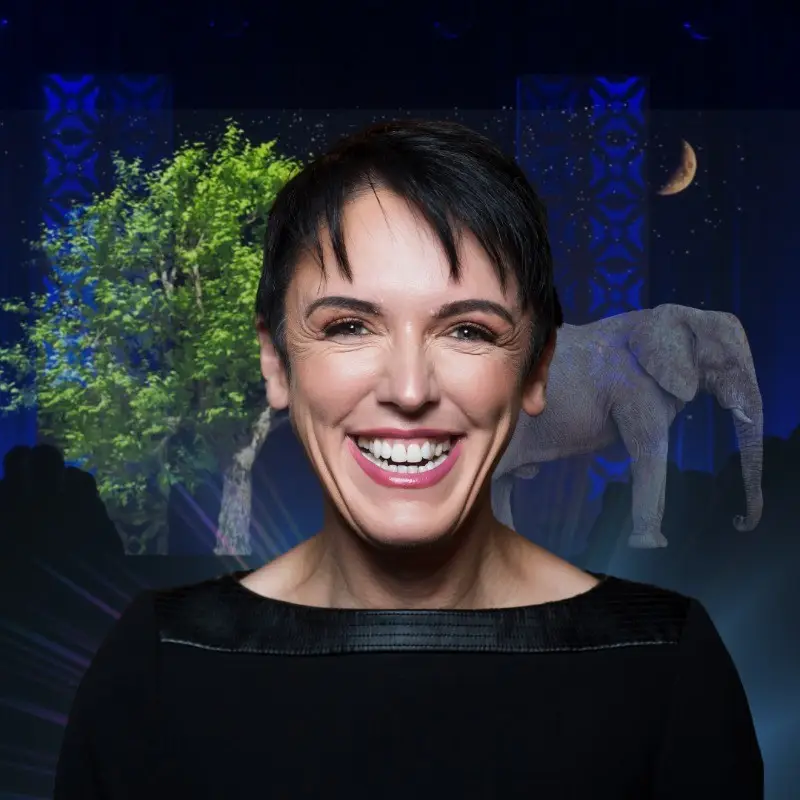
Sylvie di Giusto is an International Hall of Fame keynote speaker who works with executive audiences on the human edge that determines who thrives through structural disruption. Her Forever Human series projects the state of major industries by 2050 and examines what the human professional in those industries should be doing now to be positioned for the transition.
If your real estate team or industry conference would benefit from a keynote on the human edge that decides who leads through industry disruption, the conversation starts at sylviedigiusto.com/contact.